Mass, weight and density are fundamental physical quantities that help us understand how matter behaves, how heavy objects are under gravity, and how compact substances are.
Mass
Mass of an object is the quantity of matter in it. it remains constant regardless of location or the force of gravity acting on it.
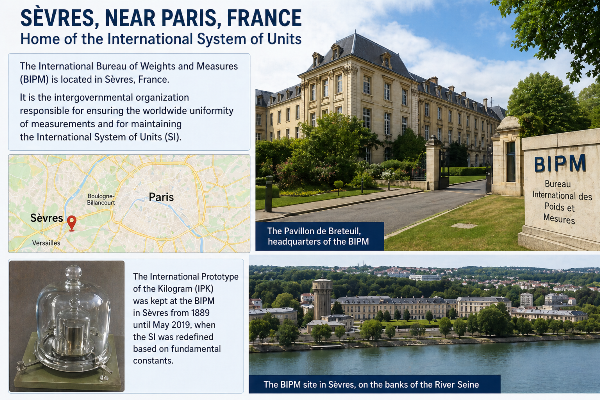
The SI unit of mass is Kilogram. The symbol for Kilogram is Kg. A kilogram is the mass of a piece of metal that is stored at Sevres, near Paris. It is used as the standard for measuring masses. Sevres is where the International office of weights and Measurements is located.
Kilogram can be broken into smaller units so that with have a sub-multiples of a kilogram which we can represent with prefixes.
the table below shows some sub-units of a gram, which is the most common unit of measuring masses. 1000 grams = 1 Kilogram.
| sub unit and symbol | equivalent in grams |
|---|---|
| picogram (pg) | 10-12 |
| nanogram (ng) | 10-9 |
| microgram (μg) | 10-6 |
| milligrams (mg) | 10-3 |
| centigrams(cg) | 10-2 |
| decigram (dg) | 10-1 |
The table belows sub units of kilogram as multiples of gram
| sub unit | equivalence in grams | equivalent in kilograms |
|---|---|---|
| Decigram(Dg) | 10 | 0.01 |
| Hectogram(Hg) | 100 | 0.1 |
| Kilogram | 1000 | 1.0 |
| tonne | 1000000 | 1000 |
Revision exercise
- Convert 0.02 g to milligrams.
- Convert 0.75 kg to grams.
- Express 250 cg as grams.
- what is 0.6 g in centigrams.
- Convert 8000 ng to micrograms.
- Convert 5 µg to nanograms.
Weight
Weight of an object is the pull of gravitational force on it. The pull of the earth, sun and moon on an object is called the force of gravity due to the earth, sun and moon respectively. The SI unit of weight is newton.
Weight of an object = mass x gravitational force
in other words: Weight(N) = mass(kg) x g (N/kg)
Density
Density of a substance is the mass of a unit cube of the substance, that is; density is mass per unit volume.
The SI unit of density is kilogram per cubic metre (kgm-3).
Another common unit of expressing density is grams per cubic centimeters (gcm-3).
Example problems
- Find the mass in Kilograms of an ice cube of side 6cm If the density of ice is 0.92gcm-3 .
solution
volume of the cube = 6cm x 6cm x 6cm = 216cm3
mass = density x volume
mass = 216cm3 x 0.92gcm-3 = 198.72 g
2. Find the volume of cork in cubic metre of mass 48g given that density of cork is 0.24gcm-3.
solution
1 cubic metre = 1000000 cm3
That is:
Leave a Reply