Factorization of Quadratic expression involves breaking down a mathematical expression of the form ax2 + bx+ c, where a, b and c are constants and a≠0. a is called the coefficient of x2, b, the coefficient of x and c the constant term.
To factorize a quadratic expression, we express it in such a way that the process of expansion can be worked backwards. This requires that the term in x be replaced by two terms chosen in such a way that the grouping method of factorization can be used.
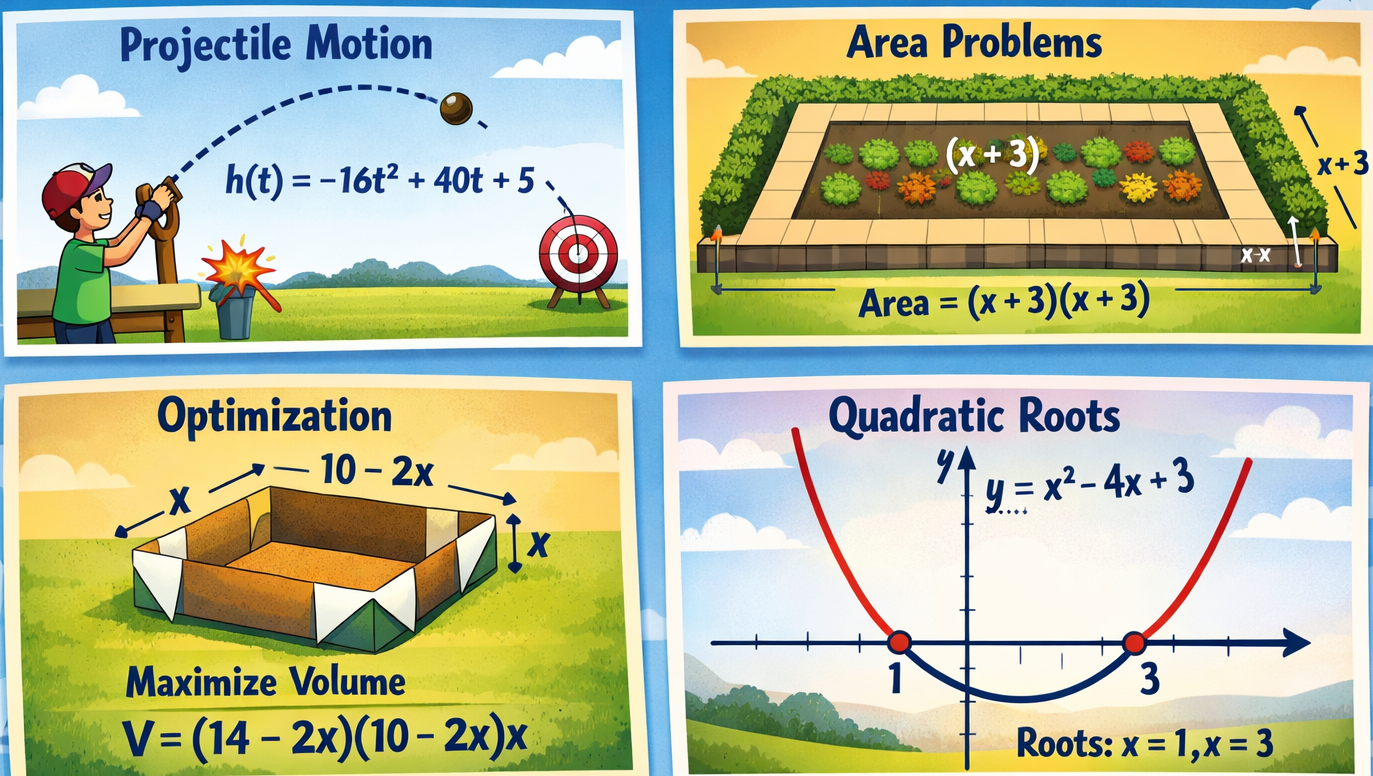
Factorization of quadratic expressions is a key algebraic skill that helps us rewrite a quadratic expression into simpler, meaningful factors. Instead of working with an expanded form like ax2+bx+c, factorization allows us to express it as a product of two binomials, making it easier to solve equations, find roots, and understand the behavior of graphs. This topic builds on earlier ideas of factors and multiplication and plays an important role in many areas of mathematics, including graphing parabolas and solving real-life problems involving area, motion, and optimization.
factorization of quadratic expression when coefficient x2 = 2
consider the expression:
(i)(x-3)(x+4) = x2+4x-3x-12 = x2+ x-12
(ii)(x+5)(x+1)= x2 +x+5x+5 = x2 +6x+5
please note: the sum of constant terms in the brackets is equal to coefficients of x in the expanded term.
that is, -3 + 4 = 1 and 5+1=6
The coefficient of x in the first expression = 1 while the coefficient of x in the second expression =6.
The product of the constant factors in the products gives the value of the constant term in the expanded expression.
in the first expression, -3 x 4 = -12 and 1 x 5 = 5
conclusion:
The sum of the constant terms in the factors is equal to the coefficient of x in the expression
the product of the constant terms in the factors is equal to the constant terms of the expression
Example 1
Factorize the expression x2+6x+8
solution
the factors will be of the form (x + a)(x + b)
a+b = 6 and a x b = 8
we need to find the values of a and b that satisfies this conditions.
one of the best way is to list the products of 8. That is:
1 x 8 = 8
2 x 4 = 8
4 x 2 = 8
we add the coefficients of the products above:
1+8 = 9
2+4 = 6
so the factors of a and b are 2 and 4. Hence the factorized form of the expression is
(x+2)(x+4)
Revision Exercise
Factorize the following quadratic exprerssions
(a) x2 – 5x +6 (b) x2+2x-35 (c)x2-10x+24
(d)x2 +4x -21 (e) x2 – 5x -6
Factorizing coefficient of x2 when a > 1
consider the expression: (4x+3)(2x+1)
we expand: 4x(2x+1)+3(2x+1) = 8x2+4x+6x+3 = 8x2+10x+3
From the quadratic expressions above, comparing ax2+bx+c
we see that a=8, b=10 and c=3
we cannot use product of 3 to get factors that make b which is 10.
but we should get product of ac, such that 3×8 = 24
product of 24 includes:
8×3
12×2
6×4
Among this, the product that gives the sum of 10 is 6 and 4
hence the factor bx = 6x+4x=10x
hence 8x2+10x+3 = 8x2+6x+4x+3
we then group them together into two: (8x2+6x)+(4x+3)
the expression then becomes : 2x(4x+3)+1(4x+3)
hence the factorized form of 8x2+10x+3 =(2x+1)(4x+3)
Generally, to factorize the expression of the form ax2+bx+c, find two numbers such that their product is ac and their sum is b. You should then split the middle term into two terms such that their coefficients are the numbers determined.
Example problem on factorization
Factorize 4x2 +6x -18
solution
The product of coefficient of x2 and that of c will be 4 x -18 = -72
The factors of -72 whose sum is 6 are -6 and 12 . That is; -6+12 = 6
splitting the bx term we get: 4x2 +12x-6x-18 = 4x(x+3)-6(x+3)
=(4x-6)(x+3)
note that (4x-6) can be factorized father because 2 can divide both 4 and 6.
The square of a number is 5 more than three times the number. Find the number.
ABC is an isosceles triangle in which AB= AC. The size of angles ABC and ACB are (3x2-2x+4)o and (9x-6)o respectively. Calculate the two possible sets of values of the three angles of triangle ABC.
A picture measuring 6cm by 9cm is mounted on a frame so as to leave a uniform margin of width x cm all around. If the area of the margin is 36cm2. find x
Quadratic expressions are algebraic expressions of the form ax2+bx+c where a, b, and c are constants and a!=0. Constants means real numbers.
if a=0, the expression would be linear rather than quadratic. When a graph of a quadratic expression is plotted against x ,is a parabola is formed.
If a is greater than 0, the curve opens upwards as shown.
shape of a quadratic curve when a > 0
If a is less than zero, the curve opens downwards as shown.
shape of a quadratic curve when a < 0
examples of quadratic expressions is like:
5x2 + 4x – 3
x2 + 2x – 1
-3x2 + 4x +10
Expanding algebraic expressions
Expanding algebraic expressions involves removing parentheses and simplifying the expression by multiplying terms and summing the like terms. Expansion makes use of the distributive property of algebra which states that a(b+c)=ab+ ac
consider the product of (x + y) and (a + b). The product can be written as (x + y)(a + b). if we let (a + b) = k, then we have kx + ky. this can be expanded to:
(a + b) x + (a+ b) y = ax + bx + ay + by
From the illustrations above, one can see that each term in the first bracket is multiplied by each term in the second bracket.
Example 1
Expand : (4x + 5)(4y + 10)
solution
each term in the first bracket is multiplied by every term in the second bracket. so we have:
Quadratic expression is an algebraic expression where the highest power is 2. Most common quadratic equations has three terms which are usually referred to as quadratic terms. The term with a power of 2 is known as the quadratic term. The term with power of one is known as the linear term. The term with power of zero in the variable is known as the constant term.
Consider the general quadratic expression ax2+bx+c where a is NOT 0.
a is known as the coefficient of x2 , b the coefficient of x and c the constant term.
consider the quadratic expression 3x2+7x +23.
3x2 is the quadratic term, 7x is the linear term while 23 is the constant term.
A quadratic expression must have the quadratic term which should be the term with the highest power of the variable.
practice problem
State why each of the following is not a quadratic expression.
5x-1
4x3 + 7x2 +3x + 15
6x4 + 5x3 + 3x2 +11x +18
Example 4
Expand and simplify each of the following:
(a) (3x – 4)(2x + 1)
(b) (2x – 7)(x-8)
(c) (3k – 2)(k-7)
solution
(a) we multiply the second bracket with each of the terms in the first bracket
Quadratic identities are formulas or equalities that hold true for all values of the variable. These identities are useful for simplifying expressions and solving equations. Some of the most important quadratic identities include:
(a + b)2= a2 + 2ab + b2
(a – b)2=a2 – 2ab + b2
(a + b)(a-b) = a2 – b2
we will prove each of the above identities in the next sections.
1. The Square of a Binomial in quadratic expressions
consider the expression: (a+b)(a+b)
we establish that: (a+b)(a+b) = (a+b)2= a2 + 2ab + b2 in all cases.
consider the square below:
The square has sides of (a + b) units. It is divided into 4 parts A, B , C and D. A is a square of side length a units while D is a square of side length b units.
B is a rectangle of length a units and width b units. C is a Rectangle of sides a and b.
The area of the whole square = (a +b)2
Area of A = a2.
Area of B = ab
Area of C = ab
Area of D = b2
The total area of the square with sides (a + b) will thus be:
a2 + ab + ab +b2
2. The Difference of Squares
This identity expresses the difference of two squares as a product of binomials: That is a2−b2=(a+b)(a−b)
consider the table below that shows English soccer results. A win scores 3 points, draw 1 point while loss wins zero points.
Team
matches played
wins
Draws
loses
Goals
points
Arsenal
25
18
5
2
49
59
Man city
25
15
5
5
51
50
Aston Villa
25
14
5
6
36
47
Man U
24
13
6
5
46
45
chelsea
23
12
5
6
45
41
Liverpool
23
11
7
5
40
40
Brentford
22
11
8
3
39
41
Sunderland
22
10
9
3
27
39
Fullham
21
9
4
8
35
31
Newcastle
19
8
5
5
35
29
with time, we may get to know what each team is scoring and remember each column values. In that case, we only need to remember the patterns only. The numerical data will thus be presented in form of a matrix as shown.
A matix is represented as a brackets or square brackets as shown:
$$\pmatrix{
a & b & c \\
d & e & f \\
g & h & i
} \ or \begin{bmatrix}
a & b & c \\
d & e & f \\
g & h & i
\end{bmatrix} $$
Capital letters in bold are commonly used to denote a matrix.
Each number in a matrix is referred to as an element of a matrix.
Order of matrices
Matrix size and shape depends on the number of rows and columns it has. If the number of rows equals number of columns, then it is a square matrix, otherwise it is a rectangular matrix.
A matrix with m rows and n columns is said to be a matrix of order m x n .
The order of matrix denotes the number of rows and columns in the matrix.
Therefore, a matrix of order 4 x 3 will have 4 rows and 3 columns.
A matrix of order 1 x n is called a row matrix.
A matrix of order m x 1 is said to be a column matrix.
A square matrix is a matrix of order m x m or n x n.
The matrix below is a square matrix of order 4 x 4:
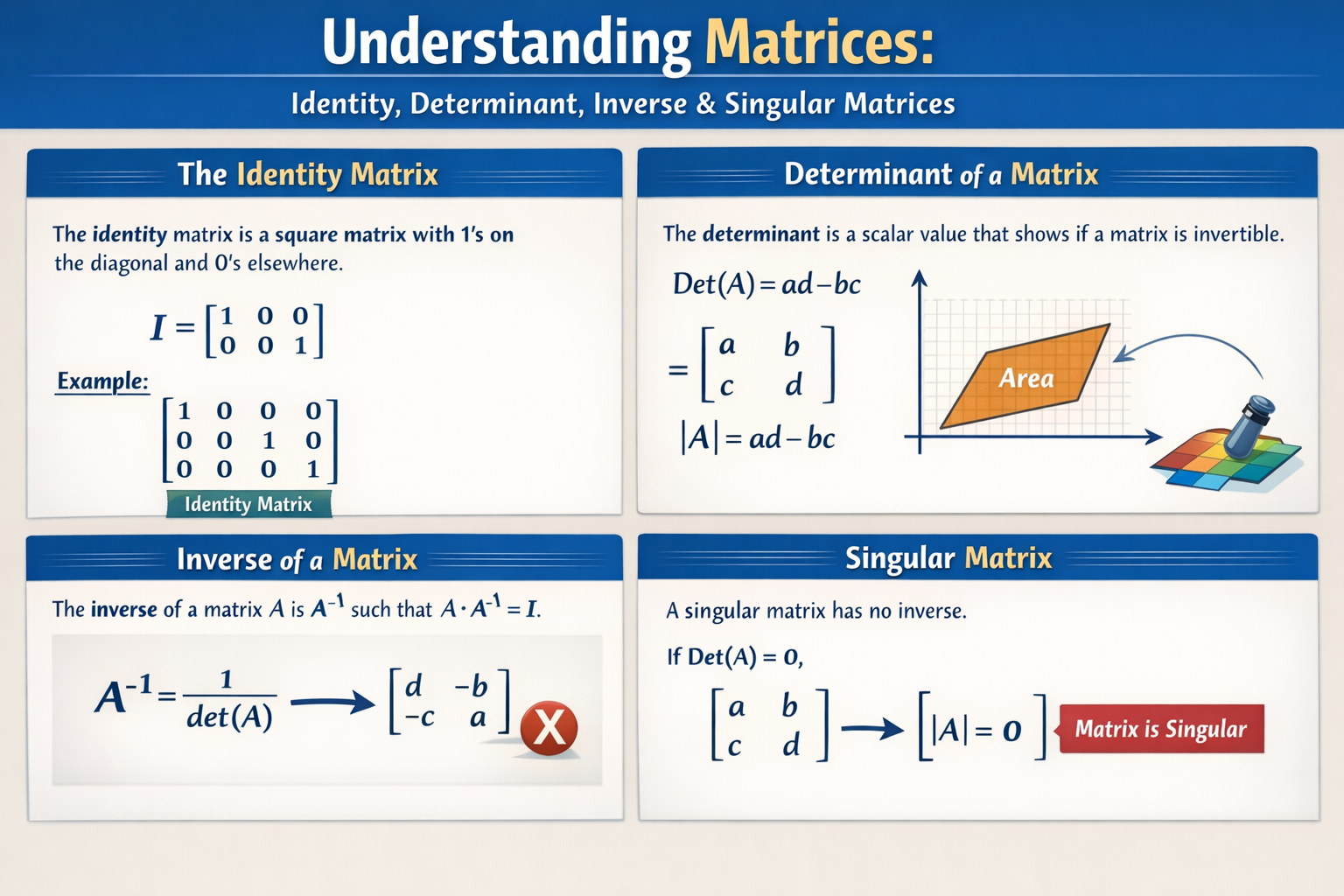
Matrices are rectangular arrangements of numbers organized in rows and columns. They are powerful tools used to represent and manipulate data in science, economics, engineering, computer graphics, and real life decision-making. Operations on Matrices includes addition, subtraction, multiplication and division, just like arithmetic operations on numbers.
computer graphics
Example of a Matrix
A = | 2   4 |
    | 1   3 |
This is a 2 × 2 matrix
2 rows, 2 columns
2. Types of Matrices (Quick Review)
Type
Description
Row Matrix
Only one row
Column Matrix
Only one column
Square Matrix
Rows = Columns
Zero Matrix
All elements are zero
Identity Matrix
1s on the main diagonal
Identity Matrix (2 × 2)
I = | 1   0 |
    | 0   1 |
Operations on Matrices
A. Addition of Matrices
Two matrices can be added only if they have the same order.
Rule:
Add corresponding elements.
A = | 2   3 |      B = | 1   4 |
    | 5   6 |          | 7   2 |

A + B = | 2+1   3+4 |
        | 5+7   6+2 |

      = | 3   7 |
        |12   8 |
📌 Real-life idea: Adding daily sales from two shops.
B. Subtraction of Matrices
Same rule as addition, but subtract corresponding elements.
A − B = | 2−1   3−4 |
        | 5−7   6−2 |

      = | 1  −1 |
        |−2   4 |
📌 Real-life idea: Comparing profits between two months.
C. Scalar Multiplication
Multiply each element by a number (scalar).
Let A = | 2   1 |
        | 3   4 |

3A = | 6   3 |
     | 9  12 |
📌 Real-life idea: Increasing production costs by a fixed rate.
D. Multiplication of Matrices
Matrix multiplication is not commutative:
AB ≠ BA (in most cases)
For matrix multiplication, the following conditions need to be met.
Number of columns in first matrix = number of rows in second matrix.
Integrating trigonometric expressions involves solving trigonometric expressions that contain trigonometric functions. These functions are periodical. They denote the relationship between the angle and the sides of a right-angled triangle.
Examples of trigonometric functions includes:
sine
cosines
tangents
secants
cosecants
cotangents
There are various techniques used to integrate mathematical expressions with trigonometric functions. Integration of trigonometric expressions requires a mix of direct integration rules. This may includes simplification using identities, substitution, and sometimes integration by parts, depending on the form of the expression. some of the techniques includes:
some know trigonometric functions and identities
some trigonometric identities are known to transform to another specific and definite trigonometric functions after the integration process. This can be very useful during Integrating trigonometric expressions. Some examples includes:
$$\int sinxdx = -cosx+c$$
The above expression shows that we always obtain a negative value of a cosine function. This negative value is accompanied by another constant number whenever the sine function is integrated.
$$\int cosxdx = sinx+c$$
in other words, integrating a cosine functions results to a positive value of a cosine function when Integrating trigonometric expressions.
(iii).∫sec2xdx=tanx+c
(iv).∫csc2xdx=−cotx+c
(v).∫secxtanxdx=−secx+c
(vi).∫cscxcotxdx=−cscx+c
2. Using trigonometric identities
by using trigonometric identities, some trigonometric expressions that could be complex to integrate becomes simplified .
When Integrating trigonometric expressions useful trigonometric identities includes:
$$sin^2x = \frac{1-cos2x}{2}$$
$$cos^2x = \frac{1+cos2x}{2}$$
$$sinxcosx = \frac{1}{2}sin2x$$
The above identities are known as power reduction identities
3. Substitution Method
Substitution method in integration is a used to simplify an integral by making a change of variables. This transforms the integral into a simpler form Integrating trigonometric expressions. It is often used when the integrand contains a composite function, making it easier to integrate.
Substitution generally has the following steps:
Identifying part of the integrand that can be replaced with a new variable (usually denoted by u).
Compute the derivative of the chosen substitution with respect to x (i.e., find du). This helps in expressing dx in terms of du.
Substitute u and du into the original integral, replacing the x-terms with the new u-terms. This aims at simplifying the integral so that it’s easier to solve.
Perform the integration with respect to u.
Once the integral is solved in terms of u, substitute the original expression for u back into the result to return to the variable x.
In trigonometric functions, the trigonometric ratio can have even or odd powers, which determines how they are treated during integration.
Integration of trigonometric expressions: 4. Integration by Parts
Integration by parts is a technique commonly used to integrate product of two functions. It is based on the product rule for differentiation derived from the following formula:
$$\int udv = uv – \int vdu $$
By applying the formula the above formula, you can reduce the complexity of the integral so that it is easier to solve.
Integration by parts may involves steps like:
Choose two functions from the integrand, u and dv, such that the integral of v is easier to compute than the original one
Compute du, the derivative of u.
Compute v, the integral of dv
Substitute u, dv, du, and v into the integration by parts formula.
If the resulting integral is easier to evaluate, solve it. If not, apply integration by parts again
Integration of trigonometric expressions:Trigonometric Substitution
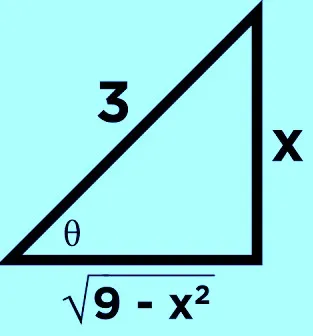
This is used when the integrand involves square roots and trigonometric functions. consider the integral:
$$\int \frac{dx}{\sqrt{1-x^2}}$$
An integral that looks like the above expression can be solved first by substituting x for sinθ such that x -sinθ = 0.
that is: x= sinθ
Integrating Even powers of sine and cosine
Integrating even powers of sine and cosine involves simplifying the integral of expressions where the powers of sine n is an even integer. These integrals can often be simplified using power reduction identities.
When powers of a trigonometric ratios are even, the double angle identities becomes very useful. These identities reduce the even powers of sine and cosine to sums of trigonometric functions of lower powers. This process makes the integration easier. These identities includes:
In general, integrating even power of sine and cosine constitutes the following procedure:
If the integrand contains an even power of sine or cosine, use the corresponding power reduction identity. This will simplify the expression.
After applying the identity, the integral often becomes easier to solve. This is because the powers of sine or cosine are reduced to terms involving cos(2x) or constants. These terms can be integrated straightforwardly.
Repeat where necessary: If higher powers of sine or cosine appear, you may need to apply the power reduction identity. You might have to do this multiple times.
Integration of trigonometric expressions: Multiple angles identities
Multiple angle identities are trigonometric identities that express trigonometric functions of multiple angles (such as 2θ, 3θ, etc.) in terms of simpler functions of a single angle θ. These identities are helpful in simplifying expressions involving trigonometric functions of multiple angles.
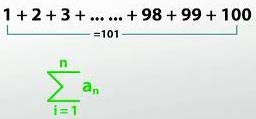
Exams test your ability to identify arithmetic sequences by looking for a constant common difference between terms, then use formulas to find any nth term (an) or the sum (Sn) of a series. You will be expected to apply formulas like
an=a1+(n−1)d and Sn=n/2(a1+an) where 𝑎1 is the first term,. d is the common difference, while n is the number of terms.
here are the questions involving sequence and series
Question 1
(a) The first term of an arithmetic progression is 3 and the sum of its first 8 terms is 164.
(i) Find the common difference of the arithmetic progression. (2 marks) (ii) Given that the sum of the first 𝑛 terms of this arithmetic progression is 570, find 𝑛. (3 marks) (b) The first, fifth and seventh terms of another arithmetic sequence forms a decreasing geometric progression. If the first term of the geometric progression is 64, find (i) The values of the common difference of the arithmetic sequence (3 marks) (ii) The sum of the first 12 terms of the geometric progression. (2 marks)
Question 2
2. An arithmetic progression of 41 terms is such that the sum of the first five terms is 560
and the sum of the last five terms is -250. Find:
(a) The first term and the common difference (5mks)
(b) The last term (2mks)
(c) The sum of the progression (3mks)
Question 3
The first term of arithmetic progression (A.P) is a and the common difference d. the 7th term of the A.P is 11. The sum of the first 12 consecutive terms of the A.P is 123.
(a) (i) Form two simplified equations involving a and d to represent the information (2mks)
(ii) Find the values of a and d. (3mks)
(a) The 1st, 3rd and 8th terms of the A.P from the first 3 consecutive terms of a geometric progression (G.P). Calculate;
(i) The 6th term of the G.P. (3mks)
(ii) The sum of the first 6 terms of the G.P. (2mks)
Angle properties of a circle refer to the specific geometric rules governing the relationship between angles formed by points, arcs, chords, and tangents within a circle.
Angles subtended by an arc or a chord
The figure below helps us study the angles subtended by an arc or a chord in the same segment at the circumference.
angle a, b and c are equal. The three angles are subtended at the circumference of the circle by the chord AC. All the three angles are in the same segment AFEDC we conclude that:
Angles subtended by the same arc or chord at the circumference, in the same arc are equal.
Angle subtended by equal arcs
Equal arcs are enclosed by equal chords. If chords of a circle are equal, then they are subtends equal angles at the circumference.
In the figure below chord AC and ZY are equal. Therefore angle ABC and angle ZXY are equal.
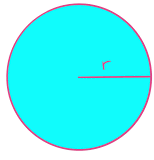
The properties of a circle include its center (the fixed point), radius , diameter, and circumference. A circle is a line which curves and joins up with itself such that any point on the line is at equal distance from a fixed point.
,
properties of a circle: Parts of a circle
Circumference of a circle
Circumference is the length of the curved line forming the circle.
An arc
An arc is a fraction of the circumference made from an incomplete circle.
chord
A chord is any straight line joining two points on the circumference.
Diameter
Diameter is any chord passing through the center of a circle. Diameter is the longest chord that can be drawn in a circle.
segment
A segment is any region enclosed by a chord and an arc. A chord usually divides a complete circle has into two segments. One segment is smaller than the other.
The smaller segment is referred to as the minor segment while the larger one is referred to as the major segment.
When a chord inside the circle makes two equal chords, then the chords are called semi-circle. In other words, a semicircle is a figure created from an area enclosed by an arc and diameter of a circle.
Sector of a circle
Sector of a circle is a two dimensional figure resulting from an area being enclosed by two radii and an arc .
Any pair of radii that joins at an angle inside a circle makes two sectors. the smaller sector is called the minor sector while the bigger sector is known as the major sector.
Angle properties of a circle
Angle subtended by an arc or a chord
Consider the figure below:
The minor arc ABC subtends and angle ADC at the circumference of the circle. Angle ADC is opposite to arc ABC.
If points A and C are joined by a straight line, chord AC or arc ABC subtends angle ADC at the circumference.
consider the figure below:
The same minor arc as describe above subtends angle AOC at the centre of the circle.
Chords AC or arc ABC subtends angle AOC at the center.
The two diagrams can help us investigate properties of angles subtended by an arc or a chord in the same segment at the circumference.
we conclude that:
Angle subtended by the same arc or chord at the circumference, in the same segment are equal
Equal chords or arcs subtends equal angles at the circumference.
A sequence in numbers is an ordered list of numbers (called terms) that follow a specific pattern or rule, such as adding, subtracting, multiplying, or dividing by a certain value to get from one term to the next. For example :
A pattern is the underlying rule or arrangement that dictates the order of items, while a sequence is the specific, ordered list of numbers or elements that follows that pattern. In other words; a pattern is the the rule(how), and a sequence is the the list of terms from the rule. in other words:
The pattern is the rule or principle governing the arrangement.
The sequence is the actual list of items that adhere to that rule.
What is a pattern?
A sequence is a list of numbers or elements arranged in a specific, connected order that follows a pattern.
In nature, pattern is the concrete, ordered set of items that results from a pattern.
A pattern can be like “add 4 to the previous number starting from 7”
The sequence would be 7, 11, 15, 19, 23, 27, 31,35,,,,,,.
Explaining sequence
A sequence is a list of numbers developed from a rule. Each number in a sequence is called a term. A sequence must come from a rule. However, a sequence can have more than one rule.
In a sequence, the terms occurs in a particular order. There is first term, second term, third term….and to infinity.
We need to establish the relationship between the value of a term and it’s position in the sequence. A position is usually represented by n. Therefore, we have 1st term, 2nd term, 3rd term,………….,n-2th term, n-1th term, nth term.
When nth term is known, any other term can be obtained using the formula developed from the rule.
consider the sequence with nth term given as 3n+2. This means the rule is that we multiply the position by 3 then add 2 to get the term in that position. To get a value for any position, we just substitute n for that position . As an example, we consider the first few positions for the sequence we defined above:
1st term: 3(1)+2 = 5
2nd term: 3(2) + 2 = 8
3rd term: 3(3) + 2 = 11
4th term: 3(4) + 2 = 14
5th term: 3(5) + 2 = 17
some commonly known sequences
Fibonacci sequence
It is a sequence obtained by adding the first two preceding’s terms to get the next term. That is:
for example, the sixth term of the sequence is the sum of 3 and 5 which are the terms preceding it. similarly 9th term is the sum of 13 and 21 which are 8th and seventh term consecutively.
example application of Fibonacci sequence
Arithmetic sequence
It is a sequence in which any two consecutive terms differs by the same number. The number is known as the common difference.
Geometric sequence
It is a sequence in which the ratio between any two consecutive terms is a constant value. For example 3,9,27,81,243…..
the ratio between 234 and 81 is 3. The ratio between 81 and 27 is 3 and so on.
Products of trigonometric functions usually refers to the integral of a product of trigonometric functions over a specified range. It can be interpreted as finding area under the curve made by a trigonometric function. For example the function:
$$\int sin(x)cos(x)dx$$
The equation represents an area under the curve formed by the product of sine and cosine functions. The integral results to
$$\int -cos(x)sin(x)dx$$
in a geometrical terms, finding the integral of products of trigonometric functions can be described as finding an area under the curve defined by those functions over a certain interval. for example:
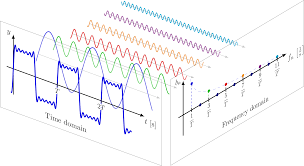
modelling of wave interference patterns in physics
describing mechanical vibrations and oscillations
used to describe AC circuits and their oscillatory behaviors
Trigonometric functions of sine and cosines
products of sines and cosines are of the form:
$$\int sin^m(x)cos^n(x)dx$$
Integrating products trigonometric functions involves use of trigonometric identities like double angle identities depending on the form of the integral.
case 1
At least one of the indices m and n is an odd positive integer. If m is an odd positive integer , then we isolate the one one sine.
consider the identity:
$$sin^2x = 1-cos^2x$$
we express the remaining sinm x as sin(m-1) x and then express it in terms of cos x. That is:
Contains information related to marketing campaigns of the user. These are shared with Google AdWords / Google Ads when the Google Ads and Google Analytics accounts are linked together.
90 days
__utma
ID used to identify users and sessions
2 years after last activity
__utmt
Used to monitor number of Google Analytics server requests
10 minutes
__utmb
Used to distinguish new sessions and visits. This cookie is set when the GA.js javascript library is loaded and there is no existing __utmb cookie. The cookie is updated every time data is sent to the Google Analytics server.
30 minutes after last activity
__utmc
Used only with old Urchin versions of Google Analytics and not with GA.js. Was used to distinguish between new sessions and visits at the end of a session.
End of session (browser)
__utmz
Contains information about the traffic source or campaign that directed user to the website. The cookie is set when the GA.js javascript is loaded and updated when data is sent to the Google Anaytics server
6 months after last activity
__utmv
Contains custom information set by the web developer via the _setCustomVar method in Google Analytics. This cookie is updated every time new data is sent to the Google Analytics server.
2 years after last activity
__utmx
Used to determine whether a user is included in an A / B or Multivariate test.
18 months
_ga
ID used to identify users
2 years
_gali
Used by Google Analytics to determine which links on a page are being clicked
30 seconds
_ga_
ID used to identify users
2 years
_gid
ID used to identify users for 24 hours after last activity
24 hours
_gat
Used to monitor number of Google Analytics server requests when using Google Tag Manager