Category: mathematics

  • Quadratic expressions and equations

    Quadratic expressions and equations

    Quadratic expressions are algebraic expressions of the form ax2+bx+c where a, b, and c are constants and a is NOT=0. Constants means real numbers.

    if a=0, the expression would be linear rather than quadratic. When a graph of a quadratic expression is plotted against x ,is a parabola is formed.

    Quadratic equations is any equation of the form ax2+bx+c=0 where a is not zero. In other words, quadratic equation is a quadratic expression that is equated to a zero as a value.

    If a is greater than 0, the curve opens upwards as shown.

    shape of a quadratic curve when a > 0

    If a is less than zero, the curve opens downwards as shown.

    shape of a quadratic curve when a < 0

    examples of quadratic expressions is like:

    • 5x2 + 4x – 3
    • x2 + 2x – 1
    • -3x2 + 4x +10

    Expanding algebraic expressions

    Expanding algebraic expressions involves removing parentheses and simplifying the expression by multiplying terms and summing the like terms. Expansion makes use of the distributive propertyof algebra which states that a(b+c)=ab+ ac

    consider the product of (x + y) and (a + b). The product can be written as (x + y)(a + b). if we let (a + b) = k, then we have kx + ky.

    this can be expanded to:

    (a + b) x + (a+ b) y = ax + bx + ay + by

    From the illustrations above, one can see that each term in the first bracket is multiplied by each term in the second bracket.

    Example 1

    Expand : (4x + 5)(4y + 10)

    solution

    each term in the first bracket is multiplied by every term in the second bracket. so we have:

    4x(4y + 10 ) + 5 (4y + 10) = 16xy +40x + 20y +50

    Example 2

    Expand (6a – 3) (4b + 7)

    solution

    (6a – 3) (4b + 7) =6a(4b + 7) -3 (4b + 7) = 24ab + 42a – 12b – 21

    Example 3

    Expand:

    (x+45)(y–14)

    solution

    (x+45)(y–14)=x(y–14)+45(y–14)

    xy–14x+45y–420

    Quadratic expressions

    Quadratic expression is an algebraic expression where the highest power is 2. Most common quadratic equations has three terms which are usually referred to as quadratic terms. A term with a power of 2 is known as the quadratic term. The term with power of one is known as the linear term. The term with power of zero in the variable is known as the constant term.

    consider the quadratic expression 3x2+7x +23.

    3x2 is the quadratic term, 7x is the linear term while 23 is the constant term.

    A quadratic expression must have the quadratic term which should be the term with the highest power of the variable.

    practice problem

    State why each of the following is not a quadratic expression.

    • 5x-1
    • 4x3 + 7x2 +3x + 15
    • 6x4 + 5x3 + 3x2 +11x +18

    Example 4

    Expand and simplify each of the following:

    (a) (3x – 4)(2x + 1)

    (b) (2x – 7)(x-8)

    (c) (3k – 2)(k-7)

    solution

    (a)

    (3x–4)(2x+1)=3x(2x+1)–4(2x+1)

    =6x2+3x–8x−4

    =6x2−5x−4

    (b)

    (2x–7)(x−8)=2x(x−8)−7(x−8)

    =2x2−16x–7x+56=

    2x2−23x+56

    (c)

    (3k–2)(k−7)=3k(k−7)−2(k−7)

    =3k2−21k–2k+14

    =3k2−23k+14

    The quadratic identities

    Quadratic identities are formulas or equalities that hold true for all values of the variable. These identities are useful for simplifying expressions and solving equations. Some of the most important quadratic identities include:

    1. (a + b)2= a2 + 2ab + b2
    2. (a – b)2= a2 – 2ab + b2
    3. (a + b)(a-b) = a2 – b2

    we will prove each of the above identities in the next sections.

    The Square of a Binomial

    consider the expression: (a+b)(a+b)

    we establish that: (a+b)(a+b) = (a+b)2a2 + 2ab + b2 in all cases.

    consider the square below:

    The square has sides of (a + b) units. It is divided into 4 parts A, B , C and D. A is a square of side length a units while D is a square of side length b units.

    B is a rectangle of length a units and width b units. C is a Rectangle of sides a and b.

    The area of the whole square = (a +b)2

    Area of A = a2.

    The Area of B = ab

    Area of C = ab

    Area of D = b2

    The total area of the square with sides (a + b) will thus be:

    a2 + ab + ab + b2

    2. The Difference of Squares

    This identity expresses the difference of two squares as a product of binomials: That is a2−b2=(a+b)(a−b)

    solving quadratic equations

    methods of solving quadratic equations includes:

    • factorization which involves rewriting the equation as a product of two binomials.
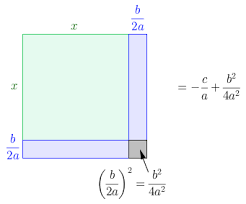
    • completing the square which involves rewriting the equation into a perfect square form.
    • the quadratic formula which is a method that is useful when the first two method cannot be work.

    solving Quadratic Equations by factorization

    consider the quadratic equation: x2+3x-54 = 0.

    we find two integers such that their products is -54 or their sum is +3.

    These numbers are -6 and 9. -6+9 = +3

    then we will replace 3x with -6x + 9x and rewrite the equation as shown:

    x2-6x+9x-54 = 0.

    we now have four terms in the expression and we can group them into twos.

    (x2-6x)+(9x-54 )= 0

    There is a common factor in each of the parenthesis.

    x(x-6)+9(x-6) = 0

    we have now two brackets with a similar expression. We join the factored values and then multiply with one of the parenthesis.

    (x+9)(x-6) = 0

    This tells us that: x+9=0 or x-6=0

    therefore: x= -9 and x=6

    therefore the solution to the quadratic equations are (6, -9).

    the solution is known as the roots of the quadratic equation.

    Related topics


  • Depreciation and appreciation

    Depreciation and appreciation

    Depreciation and appreciation are an important terms in business accountings. Appreciation is an increase in an asset’s value over time, while depreciation is a decrease in an asset’s value over time. Appreciation occurs due to factors like high demand or market popularity, increasing the asset’s worth. A good example of assets that commonly experiences appreciation is the land. Depreciation results from wear and tear, obsolescence, or negative economic factors, reducing its worth. 

    Most of the things when being used experiences wear and tear. With time, their value and usefulness reduces in the long run. The loss of value due to tear and wear is referred to as the depreciation.

    To determine depreciation, we simply multiply the given rate of depreciation of an item with its current value.

    If the current value of an item is p and it’s depreciation rate is r, the after a given period of time, it will depreciate by pr. It’s new value after depreciation thus becomes p-pr.

    Example

    An office bought a new printing machine at $30000. It’s depreciation is set to be 20% every year. What shall be it’s value 3 years later?

    solution

    after one year, the printer depreciates by 20% x $30000 = $6,000

    It’s new value becomes 30,000 -6,000 = 24,000

    after another year, it will depreciate by 20% x 24000 = 4,800

    it’s new value becomes 24,000 – 4,800 = 19,200

    After three years it will depreciate by 20% x 19,200 = 3,840

    New value after 3 years will thus be 19,200 – 3, 840 = 15, 360

    As we can see, the machine value will reduce by almost have after three years of use.

    challenge

    can you be able to find out after how many years the printer will be totally useless?

    General depreciation formulae

    sometimes, machinery can live very many years despite them depreciating in value. Some machines are made soo well such that we can use them for many years. Such machines depreciates slowly . However, we need to calculate their depreciation value so that we can plan their replacement.

    Let us set the value of an item =p and let it’s depreciation rate =r.

    We want to find the value of the item for arbitrary number of years n.

    we will try to find depreciation and value of the item for the first few years of it’s existence.

    depreciation for n years

    After first year, it depreciates to pr and it’s value becomes p-pr

    second year value

    current value = p-pr

    depreciation = (p-pr)r = pr-pr2

    new value = p-pr – (pr-pr2) = p – pr – pr +pr2 = p -2pr +pr2

    3rd year value after depreciation

    current value = p -2pr +pr2

    depreciation = (p -2pr +pr2)r = pr – 2pr2 +pr3

    new value = p -2pr +pr2 – (pr – 2pr2 +pr3 ) = p-3pr+3pr2 – pr3

    4th year value

    current value = p-3pr+3pr2 – pr3

    depreciation = (p-3pr+3pr2 – pr3 )r = pr – 3pr2 +3pr3 -pr4

    new value = p-3pr+3pr2 – pr3 – ( pr – 3pr2 +3pr3 -pr4 )

    = p-4pr +6pr2 -4pr3 + pr4

    5th year value

    current value = p-4pr +6pr2 -4pr3 + pr4

    depreciation =(p-4pr +6pr2 -4pr3 + pr4)r = pr-4pr2 + 6pr3-4pr4 +pr5

    new value = p-4pr +6pr2 -4pr3 + pr4 – (pr-4pr2 + 6pr3-4pr4 +pr5)

    =p-5pr+10pr2 – 10pr3 +5pr4 -pr5

    The expression of value for every new year is becoming length and complicated. However, a certain pattern can be determined from the expressions.

    let us list the values for the first 5 years:

    1. p-pr
    2. p -2pr +pr2
    3. p-3pr+3pr2 – pr3
    4. p-4pr +6pr2 -4pr3 + pr4
    5. p-5pr+10pr2 – 10pr3 +5pr4 -pr5

    we will now factor out p which is constant in every term and expression:

    1. p(1-r)
    2. p(1-2r+r2) = p(1-r)2
    3. p(1-3r+3r2-r3) = p(1-r)3
    4. p(1-4r +6r2 -4r3 + r4 ) = p(1-r)4
    5. p(1-5r+10r2 – 10r3 +5r4 -r5)=p(1-r)5

    From the expressions above we can see that the expression is a binomial expansion of (1-r)

    please note that we can express 1 as 1 = (1-r)0

    for the nth year it is obvious the expression will be A = p(1-r)n

    where A is the value of an item after depreciating n years at rate of r per year

    Example

    A machine has it’s value at $1000,000 while new. Determine the number of years the machine will be used before it becomes disposable at $1000.

    Appreciation

    if item is at value p, it’s new value after appreciation of rate r will be p+pr

    after 2 years, it will appreciate to (p+pr)r so that it’s value = p+pr +pr+pr2 = p+2pr+pr2 = p(1+2r+r2)=p(1+r)2

    in the third year, it will appreciate by ( p+2pr+pr2 )r = pr+2pr2+pr3

    it’s new value will become p+2pr+pr2 +pr+2pr2+pr3 = p+3pr+3pr2 pr3 = (1+r)3

    We can be able to show that the appreciation value of the item after a number of years will be given by A=p(1+r)n where n is the number of years.

    Related topics

  • Interest in commercial arithmetics

    Interest in commercial arithmetics

    In commercial arithmetic, Interest is the money paid regularly at a particular rate for the use of money lent, or for delaying the repayment of a debt.

    financial interest is the extra amount paid by a borrower to a lender for the use of money borrowed over a period of time, or the amount earned by an investor.

    Interest on money borrowed can be determined in terms of simple interest or compound interest.

    Simple Interest

    Simple interest is calculated as the product of the money borrowed , the rate of borrowing and the period of time the borrower is expected to have the money, before returning it.

    rate is the amount of money the borrower is expected to pay per every hundred borrowed. For example if the rate is 8%, it means one will pay $8 per every $100 that is borrowed.

    The formulae for simple interest is thus expressed mathematically as:

    $$Interest(I) = Principal(P) \times rate (R)\times times(t)$$ $$\text{that is:} $$ $$I = PRT$$

    As an example, consider this problem.

    Jeniffer borrowed $1000000 from a bank that charges simple interest at the rate of 10% per annum. What amount of money will Jeniffer pay to the bank if she is required to return the money after 3 years.

    solution

    I = PRT

    $$I = 1000,000 \times \frac{10}{100} \times 3 = 300,000$$

    From the above working, we see that Jeniffer’s borrowing attracts an interest of $300000. She will have to pay this interest plus the money borrowed. therefore, at the end of borrowing period, she will have to pay a total of $1,300,000 to the bank that lend her money.

    Compound Interest

    Compound Interest is when the interest earned after a certain unit of time is added back to the principal. This makes it part of the principal so that it becomes part of the money invested and starts earning interest. In other word, compound interest increases the principal by the interest earned in one particular interest period. Compound interest is commonly given to customers that invests money with financial institutions.

    bank offering loans on interest

     Compound Interest leads to exponential growth of savings or investments and can also cause debts to grow rapidly. The frequency of compounding and the length of time the money is invested significantly impact the final amount. The frequency of compounding can be daily, weekly, monthly, quarterly, semi-annually or annually or whatever other time agreed between the giver and the receiver of investiment.

    consider the problem below:

    Jane invested $100000 to a bank that gives compound interest at a rate of 12% per annum. The Interest is compounded semi annually. What is the accumulated amount after 2 years.

    solution

    The frequency of compounding is 6 months. This means one year will have 2 compounding periods. For 2 years there will be 4 periods of compounding the interest on money invested. We can use the simple interest method to calculate the interest earned in the 2 years and the total amount of money accumulated.

    The interest is per annum but the compounding period is 6 months. Therefore the interest for 6 months is simply 12% ÷ 2 = 6%

    in the first 6 months:

    $$I = 100000 \times \frac{6}{100} \times 1 = 6000$$

    the interest earned will be added to the original amount invested so that we have a new principal amount which is 106,000.

    in the next 6 months which is the second compounding period we have

    $$I = 106000 \times \frac{6}{100} \times 1 = 6360$$

    The new principal becomes: 106,000 + 6,360 = 112,360

    In the third period which is the first six month of the second year we have:

    $$I = 112360 \times \frac{6}{100} \times 1 =6,741.60$$

    The new principal now becomes: 112,360 + 6,741.60 = 119101.60

    Interest on the 4th period will thus be:

    $$I =119101.60 \times \frac{6}{100} \times 1 =7146.10$$

    The new principal = 119101.60 + 7146.10 =126,247.70

    The last new principal is the total amount of money Jane will receive upon the expiry of the investment period.

    The process of determining compound interest can be tedious. Imagine an investment for a period of 5 years with frequency of quarter of an year. That means each year will have 4 compounding periods and in five years, we have 20 compounding periods. Now imagine 10 years of such compounding. As the compounding periods increases, the process of calculating interest becomes tedious, time consuming and error prone. Good news is that, as mathematician, we can develop a general expression that can be used to calculated compound interest. This can be derived from simple interest formula.

    Let the principal amount be p and the rate of borrowing be r. The time t will always be one.

    Compound Interest formula

    We will need to find amount of money accumulated after an arbitrary period of time which we call n.

    Interest for the first period will be:

    $$I = prt = pr \times 1 = pr$$

    The new principal(A) becomes: A = p+pr = p(1 +r)

    The second period interest will be:

    $$I = (p+pr)r = pr+pr^2$$

    new Amount(A) = p+pr + pr + pr2 = p+ 2pr + pr2 = p(1 +2r + r2)

    The third period Interest will be:

    $$I = (p+2pr+pr^2)r = pr+2pr^2 + pr^3$$

    The new amount after third period is over becomes:

    A = p+ 2pr + pr2 +pr+2pr2 + pr3 = p +3pr + 3pr2 + pr4 = p(1+3r+3r2 + r3)

    Interest in the fourth period will be:

    $$I = (p+3pr+3pr^2+pr^3)r = pr+3pr^2+3pr^3+pr^4$$

    The new amount after 4th period is over becomes:

    p + 3pr + 3pr2 + pr3 + pr +3pr2 + 3pr3 + pr4 = p+4pr+6pr2 +4pr3 + pr4 = p(1+4r+6r2+4r3+r4)

    Interest on the 5th period will be:

    (p+4pr+6pr2 +4pr3 + pr4)r = pr + 4pr2 + 6pr3 + 4pr4 +pr5

    The accumulated amount after 5 periods will thus be:

    p + 4pr+6pr2+4pr3 +pr4 +pr + 4pr2 + 6pr3 + 4pr4 +pr5 =

    p + 5pr+10pr2+10pr3 +5pr4 +pr5 =p(1+ 5r+10r2+10r3 +5r4 +r5 )

    From the above working we can find the following accumulated amount at the end of each period.

    • p(1 +r)
    • p(1 +2r + r2)
    • p(1+3r+3r2 + r3)
    • p(1+4r+6r2+4r3+r4)
    • p(1+ 5r+10r2+10r3 +5r4 +r5 )

    if we factorize the expression inside the brackets, we see that it gives a binomial series

    • p(1 +r) =p (1+r)1
    • p(1 +2r + r2) = p(1+r)2
    • p(1+3r+3r2 + r3) =p(1+r)3
    • p(1+4r+6r2+4r3+r4) = p(1+r)4
    • p(1+ 5r+10r2+10r3 +5r4 +r5 ) = p(1+r)5

    if we go on and on to the nth period, we can deduce that, after n periods, the accumulated amount will be:

    A = p(1+r)n

    if we employ this formula on Jane’s case, then we have amount accumulated in the two years as:

    $$A = 100000(1+\frac{6}{100})^4 = 100000(1.06)^4 = 126, 247.70$$

    Related topics

  • Grade3 mathematics Exam

    Grade3 mathematics Exam

    Grade 3 Mathematics paper: Home work

    Grade3 Mathematics Exam paper will cover basic arithmetic in math. Areas covered includes addition, subtraction, multiplication and division.

    Related pages

    • Elementary mathematics
  • High school Math Exam papers

    High school Math Exam papers

    Math Exam papers Form Three has two sections. Section 1 has 16 questions each with 3 or 4 marks. Section B contains 7 structured questions each with 10 marks. A candidate is expected to attempt all the questions in section A and any 5 questions in section B.

    Download a pdf math exam paper form Three.

    INSTRUCTIONS:

    (i) The paper consists of two sections. Section A and Section B.

    (ii) Answer all the questions in Section A and ONLY 5 Questions in section B.

    SECTION A(50 MARKS)

    1. Without using mathematical tables or a calculator, evaluate.(3 marks)

    $$ \frac{0.0368 \times 0.25}{0.092 \times 2.0}$$

    2. Factorize completely the expression.       75x2 – 27y2                   (3 marks)

    3.Shs. 6000 is deposited at compound interest rate of 13%. The same amount is deposited at 15% simple interest. Find which amount is more and by how much after 2 years in the bank               (3 marks)

    4. The cost of 3 plates and 4 cups is Shs. 380. 4 plates and 5 cups cost shs. 110 more than this. Find the cost of each item.          (3 marks)

    5. A rectangle measures 3.6 cm by 2.8 cm. Find the percentage error in calculating its perimeter. (3 marks)

    6. 5 men can erect 2 cottages in 21 days. how many more men, working at the same rate will be needed to erect 6 cottages in the same period?   (3 marks)

    7.The figure below is a circle of radius 5 cm. Points A, B and C are the vertices of the triangle ABC. DABC = 60o and DACB = 50o which is in the circle. Calculate the area of DABC .    (4 marks)

    8. Construct triangle PQR with PQ = 5.8 cm, QR = 3.4 cm and PR = 4.1 cm. Construct a circle passing through P, Q and R. Measure its radius (4 marks)

    10. Otieno bought a shirt and paid sh 320 after getting a discount of 10%. The shopkeeper made a profit of 20% on the sale. Find the percentage profit the shopkeeper would have made if no discount was allowed?     (3 marks)

    9. ABCD is a trapezium in which AB is parallel to DC and angle . AB = 18 cm, DC = 12 cm and the area of the trapezium is 120 cm 2.

    Calculate the perimeter of the trapezium.                      (3 marks)

    11. Given that , find without using a calculator or mathematical tables.   (3 marks)

    12. Find the value of x   2(x-3) x 8(x+2) = 128      (3 marks)

    13.Two buildings are on a flat horizontal ground. The angle of elevation from the top of the shorter building to the top of the taller is 200 . The angle of depression from the top of of the shorter building to the bottom of the taller is 300. If the taller building is 80 m, how far apart are they .        (4 marks)

    14. The timetable below shows the departure and arrival time for a bus plying between two towns   M and R, 300 km apart

    TownArrivalDeparture
    M 0830 h
    N1000 h1020 h
    P1310 h1340 h
    Q1510 h1520 h
    R1600 h 

    (a) How long does the bus take to travel from town M to R? (2 marks)

    (b) What is the average speed for the whole journey?          (2 marks)

    15. Find the value of x that satisfies the equation        log (x+5) = log 4 – log(x+2)        (3 marks)

    16. Rationalize the denominator in    (2 marks)

    SECTION B(50 MARKS)ANSWER ONLY FIVE QUESTIONS ONLY

    17. (a)Complete the table below for the functions . y= 3 sin(2x – 30)  and y=cos(x  + 60) in the domain  -1800≤ x ≤1800 (2 marks).

    xo-1800-1500-1200-900-60030000300600900120015001800
    y = 3 sin(2x – 30)-1.51.5-1.51.53-3
    y  =  cos(x  +60)-0.50.8710-0.5-0.87

    (b)  On the axes draw the graphs of y  = 3 sin (2x – 30) and y=cos (x+60). Use the scale: 1 cm rep 300 on the x-axis and 1 cm rep 1 unit on the y- axis.  (5 marks)

    18.Korir and Mue decided to start a business. Korir contributed shs.40,000 and Mue shs.64000. The two men agreed that in any year, 15% of the profit shall be divided equally between them. 20% of the profit  will be used to meet the cost of running the business the following year. They also agreed to share the rest of the profit in the ratio of their contributions. The profit made after the first year was shs.43200.

    (a) How much did they set aside towards the cost of running the business for the second year?    (2 marks)

    b) How much did Mue receive at the end of the first year?  (4 marks)

    (c) Korir bought cows with his share of the profit. If each cow cost shs.1800, how many cows  did he buy?      (4 marks)  

    $$19. \text{Draw the graph of } \ y = -x^2 +3x +2 \ for -4 \le x \le 4$$

    (4 marks)

    Use your graph to solve the equations:
    (i) 3x + 2 – x2 = 0 (3 marks)

    (ii) –x2 – x = -2 (3 marks)

    20.Two tanks are similar in shape. The capacity of the tanks are 1,000,000 litres and 512, 000 litres respectively.

    (a) Find the height of the smallest tank if the larger is 300 cm tall                                         (4 marks)

    (b) Calculate the surface area of the larger tank if the smaller tank has a surface area of 1200 m2   (3 marks)

    (c) Estimate the mass of the smaller tank if the mass of the larger one is 800 kg             (3 marks)

    21. The data below are marks scored by 45 students in a Mathematics test.

    32 82 79 52 41 40 46 80 60 81 74 83 65 53 43
    50 42 31 38 80 81 43 76 45 70 51 54 84 39 42 
    80 46 71 54 72 45 35 83 41 84 70 50 78 53 55
    

    (a) Using the data above, complete the frequency distribution table below.    (2 marks)

    Marks30-3940 – 4445 – 5455 – 6970 – 7980 – 89
    Frequency

    (b) Draw a histogram to represent the data above.                    (3 marks)

    Histogram grid

    Using the histogram in (b) above, determine:

    (i) The median mark.                (3 marks)

    (ii) The number of students that failed if the pass mark was 49.5. (2 marks)

    22. Figure below represents a model. It is a solid structure in the shape of frustum of a cone with a hemisphere top. The diameter of the hemispherical part is 70 cm and is equal to diameter of the top of the frustum. The frustum has a base diameter of 28 cm and slant height of 60 cm.

    Form 3 math exam. A frustum diagram.

    Calculate :

    (a) the area of the hemispherical surface .       (2 marks)

    (b) the slant height of cone from which  the frustum was cut.  (2 marks)

    (c) the surface area of frustum.        (2 marks)

    (d) the area of the base.                          (2 marks)

    (e) the total surface area of the model.       (2 marks)

    23. Four towns P, Q, R and S are such that town Q is 120 km due East of town P, Town R is 160 km due North of Town Q, Town S is on a bearing of 330o from P and on a bearing of 300o from R

    i) Draw a sketch to show the relative positions of the town. (1 mark)

    ii) Use a ruler and a pair of compasses only. show the relative positions of towns P, Q R and S.  Take a scale of 1 cm rep 50 km.              (5 marks)Determine:  

    (i) the distance SP in km                         (2 marks)

    (ii) the bearing of S from Q                      (2 marks)

    24. The figure below represents a triangular plot ABC. The lengths of AB = 50 m, AC = 80 m  and angle BAC=30o .


     (a) Find the length of BC to 2 significant figures   (3 marks)

    (b) Find the area of the plot in hectares                          (2 marks)

    (c) The plot is fenced using 4 strands of barbed wire. The length of one roll of barbed wire is 60 m and it costs shs.4000. Calculate;

                    (i) The length of fencing wire required      (2 marks)

                    (ii) The number of complete rolls to be bought     (2 marks)

                    (iii) The cost of the rolls                              (1 mark)         

    Math exam paper Form 3

    Related topics


  • Introduction to statistics

    Introduction to statistics

    Introduction to statistics will guide us on the basic concepts as used in statistics.  Statistics is the science of data collection, organization, representation and interpretation of data or information. It plays a vital role in decision-making across various fields, including business, economics, science, and social sciences. The topic is divided into two main areas: descriptive statistics and inferential statistics.

    1. Descriptive statistics involves summarizing and organizing data. Introduction to statistics will expose us to tools include mean, median, mode, and standard deviation. Graphical representations like histograms and pie charts are also used. It helps in understanding the basic features of data.
    2. Inferential statistics focuses on making predictions or inferences about a population based on a sample. Techniques like hypothesis testing, confidence intervals, and regression analysis are used to estimate population parameters and test assumptions.

    Statistics also includes the study of probability, which underpins many statistical methods by assessing the likelihood of events. Overall, statistics is crucial for making informed decisions and understanding patterns in data.

    Please note the difference between statistics and statistic.

    Statistic

    Statistic is a collection of information shown in numbers. For example the number of people that browse a a web in a day is a statistic.

    introduction to statistics: Data as used in statistics

    Data is used to mean fact or information which needs examination or processing to extract useful information. For example counting the number of people in a location is data collection. Data collection is described as gathering of facts that are used for information processing.

    Examples of data collections include:

    • The number of items sold per category of items sold in the supermarket
    • The number of crimes or cases reported to a police station daily
    • The average fuel consumption of a country in a month
    • Number of people infected with HIV virus per day
    • The average rainfall of an area over a given period

    Introducing statistics : Data representation

    Data collected should be presented in a way that is most useful to the consumer. This means it should be represented in a way that is convenient and easy to understand. Data that is well represented will be understood and be interpreted easily.

    Some of the techniques used to represent data includes

    • Listing the data in a chronological order
    • pictograms (picture graphs)
    • bar charts
    • pie charts
    • histograms
    • Frequency tables

    Listing of data

    Listing data is simply putting down the actual numbers representing a quantity of an item in a data set. for example consider a class of 20 students that are in a computer science class that sits for a test and scored the following marks in percentage:

    82, 70, 79, 61, 56, 67, 80, 60, 55, 62, 65, 73,74, 76, 67, 78, 83, 68, 59, 49.

    Above represents a list of marks as recorded by the teacher from the students scripts. A list of numbers is not very useful on its own. However, we can make it more meaningful by arranging the items in ascending or descending order.

    From the ordered list, one can determine the highest value and the smallest value. One can also find the value that is repeated most often. Additionally, you can identify the value that is in the middle.

    If you can consider the data above, it’s ordered list will be as follow:

    49, 55, 56, 59, 60, 61, 62, 65, 67, 67, 68, 70, 73, 74, 76, 78, 79, 80, 82, 83.

    The lowest value is at the beginning of the list. The largest value is at the end of the list. As you can see from the list.

    Please note that the value that are repeated are placed next to each other.

    To get to the middle we simple divide the list size by two. For example, in the above list, we find the middle by getting a value between the 10th and 11th positions. We will be talking more about the mid value in the upcoming lessons.

    Exercise 1

    Marks scored in an English test by a group of 17 students were recorded. The total was out of 30 possible marks.

    17, 18, 12, 13, 15, 14, 17, 23, 14, 27, 24, 16, 23, 14, 21, 14, 13.

    1. List the scores in ascending order
    2. which is the most common score
    3. how many scores above the common score
    4. what is the difference between the largest and smallest value
    5. what significance can you draw from number 4 above
    6. which score is in the middle.

    Click to see Answers

    statistics symbols

    Frequency tables

    Frequency means the number of times a value is recorded or observed. It means the count of a particular value in a data set.

    A tally mark (/) is made for every occurrence of an item while counting the scores. Every 5th occurrence is stroked across the other four ////. The result of tallying is placed on a table. The value makes one column. Tallying is another column. The frequency is another column. From the table, much more manipulation of data can be done. We are likely to see that in other lessons.

    Data Manipulation in statistics

    consider the data below:

    82, 70, 79, 61, 56, 67. 80, 60, 67. 55, 62, 65. 73, 74, 76. 67, 78, 83. 68, 59, 67. 49, 64, 80. 79, 60, 55. 73, 73, 67. 74, 61, 73. 82, 83, 73, 67.

    We will make a table of three columns. In the first column, we will list every unique value that is represented in the data. The second column we will put the tallying and the third column we put the result of the tallying.

    MarkTallyingFrequency
    49/1
    55//2
    56/1
    59/1
    60//2
    61//2
    62/1
    64/1
    65/1
    67//// /6
    68/1
    70/1
    73////5
    74//2
    76/1
    78/1
    79//2
    80//2
    82//2
    83//2
    Total37

    A frequency distribution table

    Exercise 2

    The next are scores in a math class for 21 students :

    35, 30, 27, 29, 32, 31, 28, 27, 29, 30, 31, 29, 29, 34, 29, 30,27, 28,31, 31, 3035, 30, 27, 29, 32, 31, 28, 27, 29, 30, 31, 29, 29, 34, 29, 30,27, 28,31, 31, 30

    1. Arrange the data in descending order
    2. Make a frequency table for the data
    3. What is the most common mark

    Related Topics


  • Drawing Bar Graphs in statistics

    Drawing Bar Graphs in statistics

    Bar graphs consist of vertical or horizontal rectangles.We draw these rectangles on a Cartesian plane. They represent a particular data item with its frequency.

    Bar charts are especially effective with numerical data. This is when the data splits nicely into different categories. You can quickly see trends within your data.  They are best used to:

    • show change over time
    • compare different categories
    • compare parts of a whole.

    There are two types of simple bar charts:

    • Vertical or column chart –bars are moving upwards or are vertical.
    • Horizontal bar chart– This is a bar chart where the bars are horizontal.

    For vertical bar graphs, horizontal axis shows category of items and vertical axis the frequency.

    horizontal bar graphs

    For horizontal bar graphs, item categories are on vertical axis and frequency on the horizontal axis. see the figure below

    Bar graphs are particularly useful in making comparison of data. The height or length of a bar graph is directly proportional to frequency. However, the width does not have numerical significance.

    Consider a hypothetical data about daily visitors. They visit the first seven major stores in Washington. This is shown in the table below.

    We can represent the above information on a bar graph for a more appealing visualization. A typical vertical bar graph for the above data can be as in the diagram below.

    A vertical bar graph

    Vertical bar graphs

    If the same information could be represented using horizontal bar graph, it could appear as shown below:

    Horizontal bar graph

    Each unit in the horizontal scale represents 200 visitors

    By now you may have realized that a chart has 5 important elements:

    • Chart title– example: Number of visitors per day in 5 stores
    • Vertical axis title-e.g. : store name
    • horizontal axes title-e.g. : number of visitors
    • axes labels-e.g, Amazon fresh, Food lion, Gian….
    • data labels

    Chart title is arguably the most important piece of a chart. It is the element that lets the audience know what your chart is about.

    Your chart titles should be descriptive enough. At first glance, your audience should know what information the chart intends to give them. The title should also be brief and concise so that the graph is not cluttered.

    Chart title is usually placed at the top of the chart.

    Example

    The table below shows the number of students enrolled in each course in the department of Science and Engineering at Kenyatta University on January 2024.

    Draw a bar graph to show this information

    solution

    Vertical bar chart showing relationship between enrollment and course

    The vertical scale in the above chart represents 1 unit for 5 students

    Multiple Bar Graphs

    Multiple bar graphs are used when we have more than one category of data entities to analyze. For example performance of students in two or more subjects.

    For Example compare sales value of two loan products for various banks in the last one year in million dollars as shown

    Task: draw a bar graph to represent this information

    Solution

    Multiple bar graphs

    In the above chart the bar blue bar shows A mortgage sales and the orange color shows business loan.

    Divided Bar Charts

    This type of bar chart represents two or more quantities on the same bar. One category is connected in series with the other category.

    The information about bank products described above is represented as stacked graph as shown.

    stacked bar graphs

    Practice Exercise

    1. The table below presents the number of female students. It also shows the number of male students. These students are enrolled in 7 courses. The courses are offered in a semester from the department of science and Technology.

    Task:

    1. Draw a multiple graph to represent the information
    2. Draw a stacked graph to represent the information
    3. Which causes has more females compared to males
    4. which cause has the lowest number of participants

    2. Learners in grade 4 were asked to name the breeds of dogs at their homes. Their teacher recorded their responses in the table below.

    Required: Represent the data on a bar graph.

    3. The results of a mathematics tests for 30 students were as follows:

    43 62 33 45 56 32 34 39 51 65 32 43 33 32 43 45 46 44 33 45 51 56 35 33 34 45 32 42 43 62

    Required: Make a bar graph to show this information

    4. The masses of students in grade 7 and 8 were recorded as follow

    required:

    1. draw a multiple bar graphs to represent this information
    2. Represent the information using a stacked graph

    Conclusion

    In this lesson we have discussed how to represent data Using bar graphs. Bar graphs represents data in a more intuitive way. There are various ways we can draw bar graphs. This includes:

    • Vertical bar graphs
    • Horizontal bar graphs
    • Multiple bar graphs
    • stacked bar graphs
    bar graphs

    We can compare more than one entity of data in one bar graph.

    Related Topics


  • Integration by substitution

    Integration by substitution

    In Calculus, Integration by substitution is a method where we replace an integral value. We replace its parts to make the expression easier to integrate.

    Consider the function f(u) such that u is a function of x.

    let u = f(x) and f(u)=u

    $$\frac{d}{dx} f(u) = \frac{du}{dx} f'(u)$$

    where:

    $$f'(u) = \frac{df(u)}{du}$$

    Integrating….;

    $$\int \frac{du}{dx}f'(x) =\int \frac{d}{dx}f(u)dx = f(u) + C$$

    remember that:

    $$ f'(u) =\frac{df(u)}{du}$$
    $$\int f'(u)du = f(u) + c$$
    $$\int \frac{du}{dx}f'(u)dx = \int f'(u)du = f(u) + c$$

    integration by substition

    Example 1

    Solve the problem below using Integration by substitution:

    $$\int x^2 \sqrt{x^3 +5}$$

    solution

    substitute the expression under the root sign as shown:

    let

    u=x3+5u

    And then integrating u with respect to x we get:

    $$\frac{du}{dx} = 3x^2$$

    and hence:

    du=3x2dx

    and making dx the subject:

    $$dx = \frac{du}{3x^2}$$

    rewriting the expression:

    $$x^2 \sqrt{x^3+5} = \int x^2 \sqrt{u} \frac{du}{3x^2}$$

    x2 on the numerator can then be canceled out by the x2 on the denominator.

    The expression becomes:

    $$\int \frac{\sqrt{u}du}{3x^2} = \int \frac{u^{\frac{1}{2}}}{3}du=\frac{1}{3} \int U^{\frac{1}{2}} du$$
    $$\frac{1}{3}.\frac{U^{\frac{3}{2}}}{\frac{3}{2}} + c = \frac{2U^{\frac{3}{2}}}{9} + c $$
    $$\frac{1}{3}.\frac{U^{\frac{3}{2}}}{\frac{3}{2}} + c = \frac{2U^{\frac{3}{2}}}{9} + c = \frac{2}{9}{(x^3 +5)}^{\frac{3}{2}} $$

    Example 2

    solve :

    $$\int 2x \sqrt{1 + x^2}dx$$

    solution

    let u = 1 +x2

    then differentiating u with respect to x

    $$\frac{du}{dx}=2u$$

    and then rearranging:

    $$dx = \frac{du}{2x}$$

    then rewriting the integral:

    $$\int 2x \sqrt{u} \frac{du}{2x} = \int \sqrt{u}du$$

    please note that, 2x on the denominator has canceled the 2x on the numerator so that we only have u that is easy to integrate:

    $$\int \sqrt{u}du = \int u^{\frac{1}{2}}du = \left [\frac{u^{3}{2}}{\frac{3}{2}}+c \right]$$
    $$\frac{2u^{\frac{3}{2}}}{3}+c = \frac{2(1+x^2)^{\frac{3}{2}}}{3} + c$$

    Example

    solve by substitution:

    $$\int \frac{1}{\sqrt{2x+1}}dx $$

    solution

    let u = 2x + 1

    differentiating u with respect to x we obtain;

    $$\frac{du}{dx}=2$$

    now we express dx in terms of u as:

    $$du = \frac{dx}{2}$$

    Then we need to rewrite our integral as:

    $$\int \frac{1}{u^{\frac{1}{2}}}.\frac{du}{2} = \frac{1}{2} \int u^{\frac{-1}{2}}du$$

    then:

    $$\int u^{\frac{-1}{2}}du = \frac{1}{2} \left[ \frac{u^{\frac{1}{2}}}{\frac{1}{2}} \right] +c = U^{\frac{1}{2}} +c $$

    rem U = 2x + 1

    and any number raised to power of 1/2 is like finding it’s squareroot

    hence:

    $$u^{\frac{1}{2}}+c = \sqrt{2x +1}+c$$

    substitution Problem involving trigonometric ratios

    solve: ∫cosxsin3xdx

    solution:

    let u = sin x: then

    $$\frac{du}{dx} = cos \ x$$
    $$dx = \frac{du}{cos \ x}$$

    and applying substitution in our integral, we replace dx with du;

    $$cos \ x \ sin^3 \ x d x = \int cos \ x . u^3 \ \frac{du}{cos \ x }$$

    cos x in the numerator cancels the one at the denominator so that the expression is reduced to:

    $$\int u^3 du = \frac{U^4}{4}+c$$

    but u = sin x; therefore:

    $$\frac{u^4}{4}+c = \frac{sin^4 \ x}{4}+c$$

    generally:

    $$\int cos \ x sin^n x dx = \frac{1}{n+1}sin^{n+1}+c$$

    Example2 on trigonometric substitution

    solve:

    $$sin \ x cos^5 \ x dx$$

    solution

    let u = cos x

    $$du = -sinx \ dx$$ $$\frac{du}{-sinx}=dx$$

    rewriting dx in our original integral:

    $$\int sinxcos^5xdx = \int sinxcos^5x \frac{du}{-sinx} $$

    we eliminate sin x in the integral to obtain the following expression:

    $$\int -cos^5xdu$$

    but cos x = u

    hence cos5x = u5 and so the integral becomes:

    $$- \int u^5du$$

    hence we get:

    $$- \int u^5du = – \frac{u^6}{6}+c$$

    and then replacing u for cos x we get:

    $$- \frac{cos^6x}{6}+c$$

    in general:

    $$\int sinx \ cos x dx = \frac{-1}{n+1}cos^{n+1}x+c$$

    Integration by substitution: natural log by substitution

    Integration by substitution, specifically with natural logarithms, involves choosing a part of the integrand as a new variable. This is usually denoted as ‘u’ which strategically simplifies the integration process.

    The natural logarithm often appears in the denominator of a fraction where the numerator is its derivative, making it suitable for substitution.

    General Steps for U-Substitution with Natural Logarithms are as follow:

    1. Find a suitable ‘u’.

    look for a part of the integrand where its derivative is also present in the integrand. This Often will be the natural logarithm term itself, or a function containing the natural logarithm.

    2. Find du:

    First, calculate the derivative of your chosen ‘u’ with respect to the original variable, usually ‘x’. Then, express it in the form du = (derivative of u) dx.

    3. Substitute and Simplify

    Replace the original expression in the integral with ‘u’ and ‘du’. The integral should now be in a simpler form, involving a basic integration rule.

    4. Solve the new integral with respect to ‘u’.

    5. Substitute

    Replace ‘u’ with its original expression in terms of the original variable to get the final result.

    6. Add the constant of integration ‘c’:

    Since you are solving an indefinite integral, don’t forget to add the constant of integration ‘+ c’. 

    Example:

    solve:

    $$\frac{ln \ x}{x}dx$$

    solution

    let u = ln x

    $$\frac{du}{dx}=\frac{1}{x}$$

    x du = dx

    hence we write the integral as:

    $$\int \frac{ln \ x}{x}dx =\int \frac{ln \ x}{x}xdu$$

    and so we eliminate x to have the integral:

    $$\int ln x \ du = \int du$$

    ∫udu=u22+C=(lnx)22+C∫udu=u22+C=(lnx)22+C

    $$udu=\frac{u^2}{2} + c = \frac{(lnx)^2}{2}n+c$$

    Example on secant trigonometric integration

    solve:

    $$\int sec^2(3x-1)dx$$

    solution

    let u = 3x-1

    $$\frac{du}{dx}=3$$ $$du= 3dx$$ $$dx = \frac{du}{3}$$
    $$\int sec^2u\frac{du}{3} = \frac{1}{3} \int sec^2u du = \frac{1}{3}tanu+c=\frac{1}{3}tan(3x-1)+c$$

    Example 3 on trigonometric integration by substitution

    integrate:

    $$sinx \ e^{cosx}dx$$

    solution

    $$ let \ u = cos \ x$$ $$du = -sinx dx$$
    $$dx = \frac{du}{-sinx}$$
    $$=\int sinxe^u \frac{du}{-sinx}=- \int e^udu = -e^u +c$$ $$$$

    Practice exercise

    use the substitution method to evaluate the following integrals:

    $$1. \ \int x(x^2-3)^4 dx$$ $$2. \ \int x\sqrt{1-x^2 }dx$$ $$3. \ \int cos2x(sin(2x+3))^2dx$$ $$4. \ \int e^x \sqrt{1+e^x}dx$$ $$5. \ \int sec^2x tan^2xdx$$ $$6. \ \int \sqrt{x} \sqrt{1+x^{\frac{3}{2}}}dx$$ $$7. \ \int (x+1)sin(x^2 +2x +2)dx$$ $$8. \ \int (x+1) \sqrt{x^2+2x}dx$$ $$9. \ \int \frac{x^2}{(x^3+8)^4}dx$$

    Related Topics


  • Integrating products of secants and tangents

    Integrating products of secants and tangents

     When integrating products of secants and tangents, we are integrating expressions that are in the form:

    $$\int tan^m (x) sec^n(x) $$

    To integrate products of secants and tangents, the key is to utilize trigonometric identities and strategic substitutions.

     If the power of secant is even, use the identity sec²x = tan²x + 1 and substitute u = tan(x). If the power of tangent is odd, use the identity tan²x = sec²x - 1 and substitute u = sec(x).

    Secant and tangent are trigonometric functions that relate the angles of a right triangle to the ratios of its sides.

    If the integral has a factor of sec²x, let u = tan(x).Rewrite the remaining secant terms using the identity sec²x = 1 + tan²x and then substitute u and du = sec²x dx to simplify the integral to a polynomial in u

    Let u = sec(x) if the integral has an odd power of tangent. Then, rewrite the remaining tangent as tan²x = sec²x - 1. You then substitute u and du = sec(x)tan(x) dx to simplify the integral.

    There are several cases to consider in this type of integration.

    case 1 Integrating products of secants and tangents

    This is a case where m is an odd positive integer . In this case we split off the sec(x)tan(x) to form a differential sec(x)tan(x) of sec(x) along with dx.

    We then use the identity ‘sec2x = 1-tan2x‘ to convert the remaining power into powers of sec(x). This way, we prepares the integrand for the substitution of u = sec(x). consider the following:

    $$∫tan^3xsec^3xdx=∫tan^2(x)sec^2(x)sec(x)tan(x)dx$$

    u = sec(x)

    $$\frac{du}{dx}=sec(x)tan(x)$$
    $$ dx=\frac{du}{sec(x)tan(x)}$$

    hence our earlier equation becomes;

    $$ ∫(sec^2x−1)sec^2(x)sec(x)tan(x)dx$$

    substituting;

    $$∫(u^2−1)u^2du=∫(u^4−u^2)du=[u^5–u^3]+c$$ $$=sec^5x–sec^3x+c$$

    case 2 of Integrating products of secants and tangents

    This is a case where n is an even positive integer. We split sec2x to form a differential of tan(x) along with dx. We then use the identity ‘sec2x = 1 + tan2x’ to convert the remaining even powers of x into powers of tan(x). This prepares the integrand for substitution in u = tan(x). consider:

    $$∫tan^5xsec^4xdx=tan^5xsec^2xsec^2xdx=∫tan^5x(1+tan^2x)sec^2xdx$$

    u = tan(x) and du = sec2xdx

    $$∫u^5(1+u^2)du=∫(u^5+u^7)du=\frac{1}{6}tan^6x+\frac{1}{8}tan^8x+c$$

    Related topics

  • The second fundamental theorem of calculus

    The second fundamental theorem of calculus

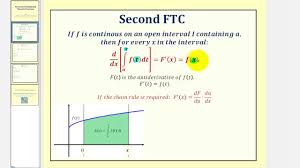
    The second fundamental theorem of calculus states that:. The derivative of a definite integral with a variable upper limit is equal to the integrals function evaluated at that upper limit.

    suppose that f is continuous between closed interval [a, b], if G is any anti-derivative of f on the closed interval [a, b], then:

    $$\int_{a}^{b} = [G(x) +c]_{a}^{b} = [G(b) +c] – [G(a) +c]$$ $$ = G(b) + c – G(a) -c = G(b) – G(a)$$

     if you have a function defined as the integral of another function  (with a variable upper bound), taking the derivative of the integral function simply replaces the variable of integration in the original function with the upper limit. 

    Example problem on second fundamental theorem of calculus

    Evaluate the following definite integrals:

    $$ a) \ \int_{0}^{3} x^2 dx $$ $$ a) \ \int_{0}^{1} x^2 \sqrt{x^3+1} dx $$

    solution

    $$ a) \ \int_{0}^{3} x^2 dx =\left[ \frac{x^3}{3} + c \right]_{a}^{b} = \left[ \frac{3^3}{3} + c \right]-\left[ \frac{0^3}{3} + c \right]$$ $$= \frac{27}{3}-0 =9$$

    $$ b) \ \int_{0}^{1} x^2 \sqrt{x^3+1} dx $$ $$ let \ u= x^3 +1 $$ $$\int_{0}^{1} = x^2 \sqrt{u} \frac{du}{3x^2} = \frac{1}{3} \int_{1}^{2} u^{\frac{1}{2}}du $$ $$du = 3x^2dx$$ $$dx = \frac{du}{3x^3} $$ $$\int_{0}^{1} x^2 \sqrt{u} \frac{du}{3x^2} = \frac{1}{3} \int_{1}^{2} u^{\frac{1}{2}} du$$ \[ = \frac{u^{\frac{3}{2}}}{\frac{3}{2}} + c = \frac{1}{3} \left[\frac{2u^{\frac{3}{2}}}{3}\right] + c \] $$= \frac{2u^{\frac{3}{2}}}{9} + c$$
    $$ \left[ \frac{2x^3 + 1}{9} + c \right]_0^1 = \frac{2}{9}(2)^{\frac{3}{2}}+c -( \frac{2}{9}(1)^{\frac{3}{2}}+c)$$ $$=\frac{2}{9}\left[2^{\frac{3}{2}}-1 \right] + c $$

    Example

    $$\int_{2}^{3}x \sqrt{x-2}dx $$ $$ let u = x-2 $$ $$ x = u+2$$
    $$\int_{2}^{3}(u+2) \sqrt{u} du = \int (u+2) ^{\frac{1}{2}} du = \int u^{\frac{3}{2}} + 2u^{\frac{3}{2}}du$$
    $$=\frac{2u^{\frac{5}{2}}}{5} +\frac{ 4u^{\frac{3}{2}}}{3}+ c$$ $$=\left[\frac{2(x-2)^{\frac{5}{2}}}{5} +\frac{ 4(x-2)^{\frac{3}{2}}}{3}+ c \right]_2^3$$

    replacing x for 2 and 3;

    $$=\left[\frac{2(3-2)^{\frac{5}{2}}}{5} +\frac{ 4(3-2)^{\frac{3}{2}}}{3}+ c \right]_2^3 -\left[\frac{2(2-2)^{\frac{5}{2}}}{5} +\frac{ 4(2-2)^{\frac{3}{2}}}{3}+ c \right]_2^3 $$
    $$=\left[\frac{2(1)^{\frac{5}{2}}}{5} +\frac{ 4(1)^{\frac{3}{2}}}{3}+ c \right]_2^3 -\left[\frac{2(0)^{\frac{5}{2}}}{5} +\frac{ 4(0)^{\frac{3}{2}}}{3}+ c \right]_2^3 $$
    $$\frac{2}{5} + \frac{4}{3} = \frac{26}{15} $$

    Example

    $$(d) \ \int_{0}^{\frac{\pi}{2}} xcosxdx $$

    solution

    from integration by parts:

    $$udv = uv – \int vdu$$
    $$let \ u = x$$ $$dv = cos x$$ $$v=sin x$$ $$du=1 dx$$
    $$(d) \ \int_{0}^{\frac{\pi}{2}} xcosxdx = xinx – \int sinxdx$$
    $$ \left [xsinx – cosx+c \right]_{0}^{\frac{\pi}{2}}= \frac{\pi}{2}sin\frac{\pi}{2} – cos\frac{\pi}{2}=\frac{pi}{2}$$

    Example

    $$e) Evaluate: \ \int \frac{x+2}{x^2-5x+6}$$

    solution

    $$\int \frac{x+2}{x^2-5x+6}=\frac{x+2}{(x-2)(x-3)}dx=\frac{A}{x-2} + \frac{B}{x-3}$$

    comparing denominator and the numerator:

    $$A(x-3)+B(x-2) = x +2$$ $$Ax-3A+Bx-2B = x +2 $$ $$Ax+bx=x$$ $$-3A-2B=2$$
    $$A +B=1$$ $$-3A-2B=2$$

    solving the two equations above simultaneously;

    B=5 and A=-4

    Rewriting the integral equation:

    $$\int \frac{x+2}{x^2-5x+6}dx = -4 \int_{1}^{2} \frac{1}{x-2} + 5\int_{1}^{2} \frac{1}{x-3}dx $$
    $$\left [ -4ln|x-2| +5ln|x-3| \right ]_{1}^{2}$$ $$=\left [ -4ln 0 +5 ln1 \right] – [-ln1 + 5ln2]$$ $$\left [ \infty+0 \right] – \left [0 +5ln2 \right]$$

    Example

    $$\int_{\frac{-\pi}{2}}^{\frac{\pi}{2}} cos^3xdx$$

    solution

    Using trigonometric identities, the integral becomes:

    $$\int_{\frac{-\pi}{2}}^{\frac{\pi}{2}} cos^3xdx =\int_{\frac{-\pi}{2}}^{\frac{\pi}{2}} cos^2xcosxdx = \int(1-sin^2x)cosxdx$$
    $$\int_{\frac{-\pi}{2}}^{\frac{\pi}{2}} cosx – sin^2xcosxdx =\left[sinx – \frac{1}{3}sin^3x \right]_{\frac{-\pi}{2}}^{\frac{\pi}{2}}$$
    $$\left [1-\frac{1}{3} – [-1 + \frac{1}{3} \right] = \frac{2}{3} +1 – \frac{1}{3} = \frac{4}{3} $$

    Revision exercise for second fundamental theorem of calculus

    $$1. \int_{0}^{\frac{1}{2}} \frac{x}{\sqrt{1-x^2} }dx $$ $$2. \int_{0}^{4} 2x\sqrt{1-x^2} dx $$ $$3. \int_{0}^{\frac{\pi}{4}}sec^2xdx $$ $$4. \int_{0}^{\frac{\pi}{2}}sinx\sqrt{cosx}dx $$ $$5. \int_{0}^{1} xe^x dx $$ $$6. \int_{1}^{2} x^3lnx dx $$ $$7. \int_{0}^{1} \frac{1}{(4-x^2)^\frac{3}{2}}dx $$ $$8. \int_{\frac{1}{2}}^{1} \frac{x-2}{(x+2)^3(x-6)^3}dx $$

    Answers to revision exercise

    $$1. \ \ 1-\frac{1}{2}\sqrt{3}$$ $$2. \ \ \frac{256}{15}$$ $$3. \ \ \frac{4}{3}$$ $$4. \ \ \frac{2}{3}$$ $$5. \ \ 1$$ $$6. \ \ 4ln2-\frac{15}{16}$$ $$7. \\ \frac{\sqrt{3}}{12} \ or \ \frac{1}{4 \sqrt{3}}$$ $$8. \\ \frac{23}{10890}$$

    Related topics