
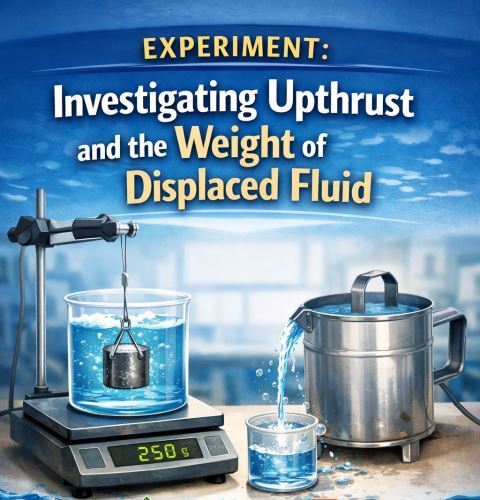
Upthrust is a force that acts on an object when it is placed in a fluid, causing the object to experience an apparent loss of weight. This experiment investigates the relationship between upthrust and the weight of the fluid displaced by an object. By observing how objects behave when immersed in a liquid, the experiment helps to verify Archimedes’ principle, which states that the upthrust on an object is equal to the weight of the fluid it displaces.
Objectives
- To show that the upthrust (buoyant force) acting on a submerged object is equal to the weight of the fluid displaced by the object — in line with Archimedes’ principle.
- To observe displacement of water
Apparatus
- Spring balance
- String
- Overflow can (Eureka can)
- Beaker or measuring container
- Water
- Solid object (e.g., metal block or stone)
Procedure
- Fill the overflow can (Eureka can) with water until it begins to pour out. Stop when it stops dripping.
- Weigh the object in air and record as W₁.
- Lower the object fully into the water and weigh it again — record this as W₂.
- The water that overflowed into the beaker is the displaced fluid. Weigh this water.
- Calculate:
- Upthrust = W₁ − W₂
- Weight of displaced fluid = (weight of beaker + displaced water) − (weight of empty beaker)
Observations Table
| Measurement | Symbol | Value |
|---|---|---|
| Weight in air | W₁ | … |
| Weight in water | W₂ | … |
| Upthrust (calculated) | W₁ − W₂ | … |
| Weight of displaced fluid | … | … |
Weighing the Object in Air
Attach the object to a spring balance and record its weight in air. see the diagram below
This shows the true weight before immersion.
1. Attach the object to a spring balance and record its weight in air.
2. This shows the true weight before immersion.
Immersing the Object in Water
Gently lower the object into the overflow can so it’s fully submerged but not touching the sides.
Collection container catches water that overflows — this is the displaced fluid.
Read and record the apparent weight shown on the spring balance (it will be less than the weight in air).
Conclusions
You should find that the upthrust (loss of weight) is equal to the weight of the displaced fluid.
This confirms Archimedes’ principle: Upthrust on an immersed object equals the weight of the fluid it displaces.
Comments
2 responses to “Experiment: Investigating Upthrust and the Weight of Displaced Fluid”
[…] Experimental investigation of Archimedes’ principle […]
[…] Experimental investigation of Archimedes’ principle […]