
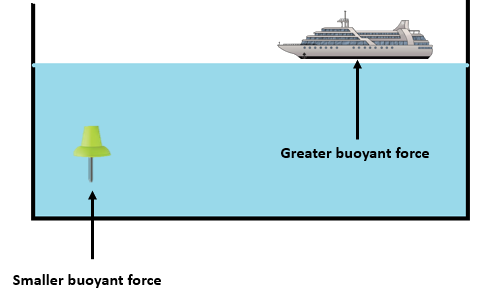
The law of floatation is considered a special case of the Archimedes’ principle. The law states that: A floationg object displaces its own weight of the fluid in which it floats.
To investigate the law of floatation
Materials/apparatus
- Measuring cylinder
- water
- test-tube
- sand
- weighing balance
procedure
- Half fill the measuring cylinder with water and record the level
- Place a clean dry test tube into the cylinder and add some sand in it until it floats as shown. Record the new water level

3. Determine the volume of water displaced
4. Remove the test tube from the cylinder, dry it and determine it’s weight
5. Repeat the procedure five times, adding a little more sand each time and recording the volume of water displaced. Record the results in a table shown.
| Weight of sand and testtube (N) | Volume of water displaced(cm3) | Mass of water displaced(kg) | Weight of water displaced(N) |
|---|---|---|---|
observations and conclusions
- The test tube sinks deeper every time some some is added
- Weight of the test tube and it’s content is equal to the weight of water displaced
Experiment 2
Materials Needed:
- Beaker or a transparent container (1–2 L)
- Water
- Objects of different densities and shapes (wood, plastic, metal, cork)
- Spring balance (optional, for measuring weight)
- Measuring cylinder or scale
- Graph paper (for recording observations)
- Ruler
Procedure:
- Preparation:
- Fill the beaker with water about 3/4 full.
- Record the water level.
- Observation of Floating and Sinking:
- Gently place each object in water one by one.
- Observe whether it floats, sinks, or partially floats.
- Measurement (Optional for Quantitative Study):
- Measure the weight of each object using a spring balance.
- Observe how much of the object is submerged when it floats.
- Record the depth of submersion.
- Changing Variables (Shape & Density):
- Take a piece of aluminum foil and make it into a flat sheet, then into a boat shape.
- Place it in water and observe whether the shape affects flotation.
- Record Observations:
- Note which objects float and which sink.
- For floating objects, note the fraction submerged.
Variables:
- Independent Variable: Type of object (density, material, shape)
- Dependent Variable: Whether the object floats or sinks, depth of submersion
- Controlled Variables: Volume of water, temperature of water, same container
Expected Observations:
- Objects denser than water will sink (e.g., metals like iron).
- Objects less dense than water will float (e.g., cork, wood).
- Changing the shape of an object can make it float even if it is denser than water (e.g., aluminum foil boat) because it displaces more water.
Conclusion:
- An object floats if the upthrust (buoyant force) is equal to its weight hence verifying the law of floatation.
- The fraction of the object submerged depends on its density relative to water.
- The shape can influence flotation by changing how much water is displaced.
Example problem
A ship of mass 250000kg floats on flesh water. If the ship enters the sea, determine the load that must be added to it so that it displaces the same volume of water as before. (Take density of fresh water as 1000Kgm-3 and that of sea water as 1025kgm-3)
solution
weight of the ship = 250000kg x 10Nkg-1 = 25000000 N
from the law of floatation: weight of flesh water displaced = weight of the ship
Volume of sea water displaced when more load is added = 250m3
mass of sea water displaced = 250m3 x 1025kgm3 = 256,250kg
weight of the sea water displaced = 2,562,500 N
Extra load needed = weight of sea water to be displaced – weight of flesh water displaced
= 2,562,500N – 2,500,000N = 62, 500N
Comments
One response to “The law of floatation”
[…] The law of floatation […]