
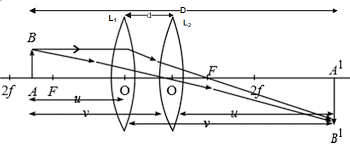
Focal length by displacement is a method of estimating focal length of a lens where we change the position of a lens and observe the image formed on a screen while distance between object and the lenses is unchanged.
Ensure you have the following apparatus:


metre rule
Procedure to estimate focal length by displacement
- Estimate the focal length of the lens by focusing a distance object
- Set the apparatus as in figure below ensuring that the distance between the object and the screen is more than 4f where f is the focal length estimated above.

- Obtain the image of the illuminated object on the screen when the lens is at position L1
- move the lens to position L2 where another clear but diminished image is formed on the screen as Without changing the position of the object on the screen, shown below.

- measure u and v for position L1 and the new distance u1 and v1 for position L2.
- Determine the displacement d .
Deriving the displacement formular
from the diagram above, the distance between the point object and the screen is s. from the diagram, it is shown that the distance s is given by u+v.
Advertisement
i. e. s = u+v ………………………………..(1)
we get the distance between new and original position of the lens by use of expressions:
d=u’- u where u’ is the new object distance and u the original object distance
d can also be obtained from v-v’ which is the original image distance and image distance when the lens is displaced by distance d.
i.e d=u’-u and d = v-v’
but u’=v and v’=u
and therefore:
d=v-u………………………………….(2)
adding (1) and (2);
hence s+ d= u + v + v –u
and so: s + d = 2v and hence;
similarly we can subtract equation 2 from 1 as shown:
hence s- d = u + v –v + u
therefore : s- d = 2u and hence;
from the lens formulae:
we can substitute values of u and v in terms of s and d as obtained in the expressions above. And hence;
the above equation can be simplified into:
finding the lcm of the denominator, we obtain;
1f=2(s+d)+2(s−d)(s−d)(s+d)=2s+2d+2s−2ds2−d2
and simplifying the above equation in the numerator:
and finding the reciprocal so that we can get f;
f=s2–d24s
from the above equation: s2-d2 = 4fs
a plot of s2-d2 against s results to a straight line through the origin with a slope equal to 4f.
different values of s are obtained by changing distance between the object and the screen and then calculating the corresponding distance d.
The two positions L1 and L2 that represents different positions of the lens are known as the conjugate points.