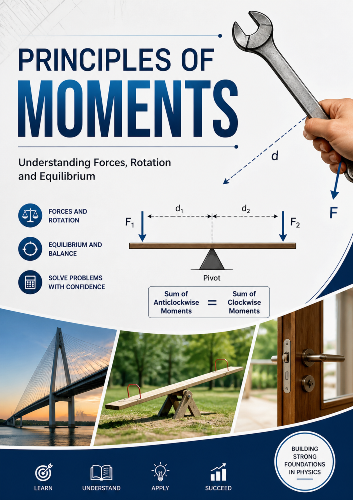
The principle of moments is a fundamental concept in physics that explains how forces cause objects to rotate and how balance is achieved. Whether it is a seesaw, a door, or a bridge, understanding how forces act at different distances from a pivot helps us predict and control motion. By studying moments, we learn not only how to calculate turning effects but also how real-world structures remain stable under various forces. This topic forms an important foundation for mechanics and is widely applied in engineering, construction, and everyday problem-solving.
🌍 Introduction
From opening a door to balancing a seesaw, rotation is part of everyday life. The principle of moments helps us understand how and why objects turn, balance, or remain stable under the action of forces.
This concept is fundamental in physics and engineering, forming the basis for analyzing structures such as bridges, cranes, beams, and even the human body.
⚙️ What is a Moment?
A moment is the turning effect produced by a force about a fixed point called a pivot (or fulcrum).
👉 The larger the force or the further it is from the pivot, the greater the turning effect.
Mathematical Definition of principles of moments:
Where:
- M = Moment (Newton metre, Nm)
- F = Applied force (Newtons, N)
- d = Perpendicular distance from pivot to the line of action of the force (metres, m)
Understanding Perpendicular Distance 📐
It is not just the distance—it must be the shortest distance from the pivot to the line of action of the force. This is called the perpendicular distance.
Important:
- If the force is applied at an angle, you must resolve it or find the perpendicular component.
- Using the wrong distance is one of the most common mistakes.
🔄 Direction of Rotation
Moments can act in two directions:
- Clockwise moment → turns the object to the right
- Anticlockwise moment → turns the object to the left
In calculations:
- Choose one direction as positive (commonly anticlockwise)
- The other becomes negative
⚖️ Equilibrium of a Body
A body is said to be in equilibrium when it satisfies two conditions:
1. Translational Equilibrium
- No movement in any direction
- Resultant force = 0
2. Rotational Equilibrium
- No turning effect
- Resultant moment = 0
📏 Principle of Moments
This principle combines rotational equilibrium into a simple rule:
For a body in equilibrium, the sum of clockwise moments about a point equals the sum of anticlockwise moments about the same point.
Mathematically:
$$
\text{Sum of clockwise moments} = \text{Sum of anticlockwise moments}
$$
🧠 Why the Principle Works
If clockwise moments were greater, the object would rotate clockwise.
If anticlockwise moments were greater, it would rotate anticlockwise.
👉 Therefore, equality ensures balance.
🏗️ Real-Life Applications
The principle of moments is used in:
- Seesaws → balancing children of different weights
- Spanners (wrenches) → longer handles produce more turning effect
- Door handles → placed far from hinges for easier opening
- Bridges and buildings → ensuring stability under loads
- Human body → muscles create moments around joints
🧠 Worked Examples
Example 1: Finding Distance
A force of 20 N produces a moment of 100 Nm.
$$
d = \frac{100}{20} = 5 , m
$$
👉 Distance = 5 m
Example 2: Multiple Forces on a Beam
A beam is in equilibrium:
- Left side: 30 N at 3 m
- Right side: 10 N at 2 m and another force (F) at 1 m
$$
30 \times 3 = (10 \times 2) + F
$$
$$
90 = 20 + F
$$
$$
F = 70N
$$
👉 Missing force = 70 N
Example 5: Taking Moments About Different Points
A beam has forces acting at different positions. Choosing the pivot wisely simplifies calculations.
Always take moments about a point where unknown forces act to eliminate them from the equation.
⚠️ Common Mistakes to Avoid
- Using wrong distance (not perpendicular)
- Ignoring direction of moments
- Forgetting to include all forces
- Not choosing a convenient pivot
- Mixing up units (always use Nm)
🧩 Advanced Insight
Moment as Torque
In more advanced physics, moment is also called torque, especially in rotational dynamics.
Sign Convention
You may use:
- Anticlockwise = positive
- Clockwise = negative
This helps when solving complex equations.
📝 Practice Questions
- A force of 18 N acts 2.5 m from a pivot. Find the moment.
- A moment of 72 Nm is produced by a force of 12 N. Find the distance.
- A beam balances with:
- 40 N at 3 m (left)
- F at 6 m (right)
Find F.
- A uniform beam is supported at a pivot. Forces act at different points—determine the unknown force required for equilibrium.
- Explain why a long spanner is more effective than a short one.
🎯 Summary
- A moment is the turning effect of a force
- It is calculated using:
$$
M = F \times d
$$ - A body is in equilibrium when:
- Resultant force = 0
- Resultant moment = 0
- Principle of moments ensures balance:
- Clockwise moments = Anticlockwise moments
Final Thought
Understanding moments allows you to analyze and design systems that remain stable under forces. Whether in engineering, construction, or daily life, this principle is essential for solving real-world problems involving balance and rotation.
Related topics
- Introduction to pressure
- Exam questions on photoelectric effect
- Principles of Moments 3 : Example and Application of the.
- https://www.youtube.com/watch?v=eXVqEY7w7xc

Leave a Reply