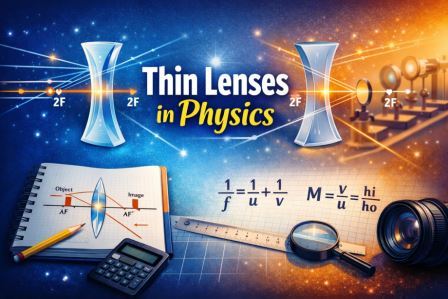
This lenses operates from the principles of light refraction(bending) when the medium of transmission changes. Questions on thin lenses test several important physics concepts. These include:
1. Refraction of Light
- Bending of light when it passes from one medium to another
- How curved surfaces (lenses) change the direction of light rays.
- Application of Snell’s Law (conceptually, even if not directly calculated).
II . Image Formation
Understanding how images are formed by:
- Convex (converging) lenses
- Concave (diverging) lenses
A learner must know:
- When images are real or virtual
- if images formed upright or inverted
- Whether image formed is
- magnified or diminished
III. Ray Tracing Principles
Use of the three principal rays:
- Ray parallel to the principal axis
- Rays through the optical centre
- Ray through the focal point
This tests geometric understanding of light behavior.
iv. Lens Formula (Mathematical Relationship)
Tests:
- Algebraic manipulation
- Substitution and rearrangement
- Use of correct sign convention
v. Magnification
M=uv
or
Tests:
- Proportional reasoning
- Understanding of image size relationships
vi. Graphical Skills
Some questions require:
- Scale diagrams
- Plotting graphs
- Determining focal length from graphs
vii. Experimental Skills
Students may be tested on:
- Determining focal length experimentally
- Sources of error
- Drawing conclusions from results
viii. Concept of Proportionality
Especially in experiments relating object distance, image distance, and focal length.
Some examination Questions on Thin Lenses
Question 1 (Thin lenses)
- (a) State the meaning of the term “principal focus” as applied in thin lenses. (1 mark)
- (b) you are provided with the following apparatus to determine the focal length of a lens:
-a biconvex lens and lens holder.
-a lit candle
-a white screen.
-a metre rule
(i) Draw a diagram to show how you would arrange the above apparatus to determine the focal length of the lens (1 mark)
(ii) Describe the procedure you would follow. (1 mark)
(iii) state two measurements that you would take (2 marks)
(iv) Explain how the measurements in (iii) would be used to determine the focal length. (2 marks)
(c) An object is placed 30 cm infront of a concave lens of focal length 20 cm. Determine the magnification of the image produced. (4 marks)
Question 2
(a) state 2 applications of convex lenses (2 marks)
(b) A form 4 student did an experiment on thin lenses by varying the object distance and recording the corresponding image distance for the formed by the lenses in an attempt to determine the focal length.
| Object distance u (cm) | Image distance V (cm) | UV (cm2) | (U+V)cm |
| 15 | 30 | ||
| 20 | 20 | ||
| 25 | 16.7 | ||
| 30 | 15 | ||
| 40 | 13.3 | ||
| 60 | 12 |
On the grid provided, plot the graph of uv against u+v (5 marks)
