Category: Physics

  • Perfect squares

    Perfect squares

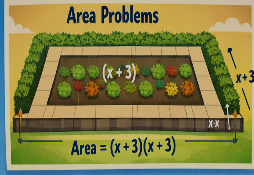
    A perfect square is a number that is obtained when a whole number is multiplied by itself. In other words, it is the result of squaring an integer. For example, 1=1×1, 4=2×2, 9=3×3, and 16=4×4. These numbers are called perfect squares because they can be arranged to form a perfect square shape.

    Perfect squares are important in mathematics because they help us understand square roots, area, and patterns in numbers. The square root of a perfect square is always a whole number. For instance, the square root of 25 is 5, since 5×5=25.

    in quadratic expressions, a perfect square occurs when the expression can be written as the square of a binomial. This means the quadratic can be expressed in the form:

    When expanded, these forms follow special patterns:(a+b)2=a2+2ab+b2(a + b)^2 = a^2 + 2ab + b^2(ab)2=a22ab+b2(a – b)^2 = a^2 – 2ab + b^2

    A quadratic expression is called a perfect square trinomial if:

    1. The first term is a perfect square.
    2. The last term is a perfect square.
    3. The middle term is twice the product of the square roots of the first and last terms.

    Examples

    x2+6x+9 is a perfect square

    Example 2

    assume x2−10x+25 is a perfect square


    Importance in Solving Quadratics

    Perfect square expressions are useful because:

    • They make factorization easier.
    • They help in completing the square, a method used to solve quadratic equations.
    • They simplify graphing, since expressions like (xa)2(x – a)^2 clearly show the vertex of a parabola.

    Example problem

    factorize x2 – 8x +16

    solution

    The constant term is a perfect square

    middle term is twice the constant term

    hence 16 = (4)(4)

    -8 = -4-4

    hence x2 – 8x +16 = (x-4)(x-4) = (x-4)2

    example

    factorize:

    $$x^2+\frac{4}{3}x+\frac{4}{9}$$

    solution

    $$\frac{4}{9} = \frac{2}{3} \ or \ (\frac{-2}{3})$$
    $$\frac{4}{3}= \frac{2}{3}+\frac{2}{3}$$
    $$x^2 + \frac{4}{3}x + \frac{4}{9} = (x+\frac{2}{3})^2$$

    Example

    factorize 4x2+20x+25

    solution

    4x2= (2x)(2x)

    25=(5)(5)

    hence 4x2+20x+25 = (2x+5)(2x+5) = (2x+5)2

    completing the square

    Completing the square is a method used to solve quadratic equations and rewrite quadratic expressions in a special form. It helps us change a quadratic expression into a perfect square trinomial, which can then be factored easily.

    consider the expression x2 +bx

    we can add a constant term such that the expression becomes a perfect square.

    To complete the square:

    Take half of ,square it and then add it to the expression.

    that is: add (b/2)2 to the expression

    Example problem on completing the square

    what must be added to x2 -18x to make it a perfect square?

    $$\text{we must add}: (\frac{1}{2} \times (-18)^2 =(-9)^2 =81$$

    so x2 -18x is transformed to x2 -18x+81 to be a perfect square.

    Related Topics
  • Upthrust in gases

    Upthrust in gases

    Upthrust in gases is the upward force exerted on an object immersed in a gas, which opposes the object’s weight. Upthrust in gases acts as an upward force on an object immersed in a gas and opposes the object’s weight. It arises from the pressure difference between the top and bottom of the object due to the gas’s density. This concept is similar to upthrust in liquids but involves the behavior of gases, which are much less dense than liquids.

    When an object is placed in a gas, the pressure at the bottom of the object is greater than the pressure at the top. This difference in pressure results in an upward force (upthrust). This is what that results to upthrust in gases. The size of this force depends on the volume of the displaced gas and the density of the gas.

    Just like liquids, gases exerts upthrust on objects that are in them. Air is the most common gas of interest and so it will be used extensively to illustrate upthrust in gases. We float objects on air. Sometimes, as human beings, we use parachutes to float in air.

    The upthrust in gases is small because air has lower density compared to most of substances.

    The density of air is about 1.3kgm-3 or 0.0013gcm-3.

    A balloon can float in air if it contains a gas with a lower density than air. For example hydrogen has a density of 0.09 kgm-3 whereas helium has a density of 0.18kgm-3. Therefore a balloon filled with helium or hydrogen will rise on air provided density of the balloon fabric and air will be less than density of air.

    Problems involving upthrust in gases

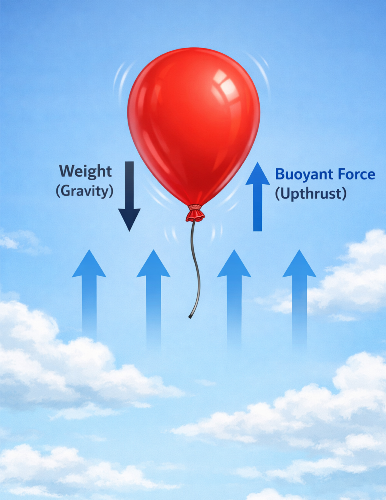
    Consider the figure below that illustrates a balloon filled with air .

    If we consider the balloon filled with air to a certain volume, the weight of air in the balloon plus its fabric is greater than the weight of air displaced. This is because the volume of air in the balloon is nearly equal to the volume of air displaced.

    The upthrust force on the balloon due to the air is thus less than the weight. The balloon thus stay grounded because the it’s weight is less than the upthrust force that could set it up to float on air.

    That is W-U > resultant downward forces.

    If the balloon is filled with a gas that has a lower density than air, the gas and balloon fabric weigh less than the displaced air. The upthrust force U exerted by the air on the balloon is greater than the weight W of the inflated balloon. This results in the upthrust force being larger. The resultant upward force is greater than W-U and hence the balloon sets to accelerate upward.see the illustrations below.

    illustrating upthrust in gases
    Example Question

    A meteorological balloon has a volume of of 55m3 and is filled with a helium gas of density 0.18kgm-3. If the weight of the balloon fabric is 170N, calculate the maximum load the balloon can lift given that density of air is 1.3kgm-3

    solution

    Volume of air displaced by the balloon is 55m3 which is volume occupied by the balloon.

    mass of air displaced by the balloon = 55m3 x 1.3kgm-3 = 71.5kg

    weight of air displaced =71.5kg x 10 Nkg-1 = 715N

    mass of helium in the balloon = 55m3 x 0.18kgm-3 = 9.9Kg

    weight of helium in the ballon = 9.9kg x 10 Nkg-1 = 99N

    Total weight of the inflated balloon = 170N + 99N = 269 N

    From the law of floatation, upthrust is the weight of air displaced which should also be weight of the balloon plus the weight of load it will carry. hence,

    upthrust = weight of the balloon + load in the ballon = weight of air displaced

    269N + load in the ballon = 715N

    load in the balloon = (715-269)N=446N

    So the total mass of the goods to be included in the balloon should never exceeded 44.6kg.

    Related topics
  • Alphabetical letters (A B C)

    Alphabetical letters (A B C)

    Alphabetical letters are the basic symbols used to form words and communicate ideas in written language. They help us read, write, and understand information in an organized and meaningful way.

    capita Alphabetical letters

    Alphabetical letters

    small alphabetical letters

    small letters

    Related posts

  • Historical sites in Kenya

    Historical sites in Kenya

    Kenya has a rich tapestry of history and heritage — from ancient Swahili cities and prehistoric fossil sites to colonial forts and caves that tell the story of the fight for independence. Here are some notable historical sites in Kenya you might find fascinating:

    Some Historical sites in Kenya

    Related topics


  • Sources of water

    Sources of water are the natural places from which humans, animals, and plants obtain water for their daily needs. The main source of water is rain, which supplies rivers, lakes, and underground water. Surface water comes from rivers, lakes, streams, and dams, while groundwater is found below the earth’s surface in wells, boreholes, and springs. Oceans and seas are also sources of water, although their water is salty and must be treated before it can be used for drinking. These sources of water are very important because they support life, agriculture, and economic activities.

    showing sources of water

    Related topics

  • UPTHRUST IN GASES

    UPTHRUST IN GASES

    1. Introduction

    Gases, just like liquids, are fluids and can exert forces on objects placed in them. Although air cannot be seen, it has mass, occupies space, and exerts pressure. When an object is placed in air, it experiences an upward force known as upthrust. This force explains why balloons rise, smoke moves upward, and parachutes slow down falling objects.


    2. What Is Upthrust?

    Upthrust (buoyant force) is the upward force exerted by a fluid (liquid or gas) on an object immersed in it.

    In gases, upthrust occurs because air pressure increases with depth. The pressure acting on the bottom of an object is greater than the pressure acting on the top, resulting in a net upward force.


    3. Archimedes’ Principle in Gases

    Archimedes’ principle also applies to gases and states that:

    An object wholly or partially immersed in a gas experiences an upthrust equal to the weight of the gas displaced.

    This means the greater the volume of air displaced by an object, the greater the upthrust acting on it.


    4. Mathematical Expression for Upthrust in Gases

    The upthrust in gases can be calculated using the formula:U=ρgVU = \rho g VU=ρgV

    Where:

    • UUU = upthrust (N)
    • ρ\rhoρ = density of the gas (kg/m³)
    • ggg = acceleration due to gravity (m/s²)
    • VVV = volume of gas displaced (m³)

    5. Conditions for Floating, Rising, and Falling in Air

    illustrating upthrust in gases
    Illustrating upthrust in gases
    Comparison of ForcesResult
    Upthrust > Weight of objectObject rises
    Upthrust = Weight of objectObject floats
    Upthrust < Weight of objectObject falls

    6. Illustrations of Upthrust in Gases

    (a) Balloons

    A helium or hot-air balloon rises because it displaces air that is denser than itself. The upthrust acting on the balloon is greater than its weight, causing it to rise upward.

    (b) Parachutes

    When a parachute opens, it increases the surface area and displaces more air. The upthrust (and air resistance) acting upward increases, reducing the downward motion of the parachutist and allowing a safe landing.

    (c) Smoke and Hot Air

    Hot air and smoke rise because they are less dense than the surrounding cooler air. The upthrust acting on them is greater than their weight.


    7. Worked Examples

    Example 1:

    An object displaces 0.1 m³ of air. Given that its’ density of air = 1.2 kg/m³ and the acceleration due to gravity = 10 m/s². calculate upthrust in air.

    Calculate the upthrust acting on the object.

    Solution:U=ρgVU = \rho g VU=ρgV U=1.2×10×0.1U = 1.2 \times 10 \times 0.1U=1.2×10×0.1 U=1.2NU = 1.2 \, \text{N}U=1.2N

    Upthrust = 1.2 N


    Example 2: Determining Motion of an Object in Air

    A balloon has a weight of 0.9 N.
    Upthrust acting on it is 1.2 N.

    Since:Upthrust>Weight\text{Upthrust} > \text{Weight}Upthrust>Weight

    The balloon will rise.


    Example 3: Volume of Air Required for Floating

    An object has a weight of 2.4 N.
    Density of air = 1.2 kg/m³, g=10m/s2g = 10 \, \text{m/s}^2g=10m/s2

    Calculate the minimum volume of air the object must displace to float.2.4=1.2×10×V2.4 = 1.2 \times 10 \times V2.4=1.2×10×V V=2.412V = \frac{2.4}{12}V=122.4​ V=0.2m3V = 0.2 \, \text{m}^3V=0.2m3

    Required volume = 0.2 m³


    8. Problems Involving Upthrust in Gases

    1. A balloon displaces 0.25 m³ of air.
      Density of air = 1.2 kg/m³, g=10m/s2g = 10 \, \text{m/s}^2g=10m/s2.
      Calculate the upthrust acting on the balloon.
    2. An object weighs 3 N and experiences an upthrust of 2 N in air.
      State whether the object will rise, float, or fall, giving a reason.
    3. Explain why a parachutist falls slowly after opening a parachute.
    4. A hot-air balloon displaces 1.5 m³ of air.
      Calculate the upthrust acting on the balloon.
    5. State two applications of upthrust in gases in everyday life.

    9. Conclusion

    Upthrust in gases is an important concept that explains the behavior of objects in air. It depends on the density of the gas, the volume displaced, and gravity. Understanding upthrust helps explain real-life phenomena such as balloons rising, parachutes slowing descent, and hot air moving upward.

    Related topics

  • The Key Concepts in Matrices

    The Key Concepts in Matrices

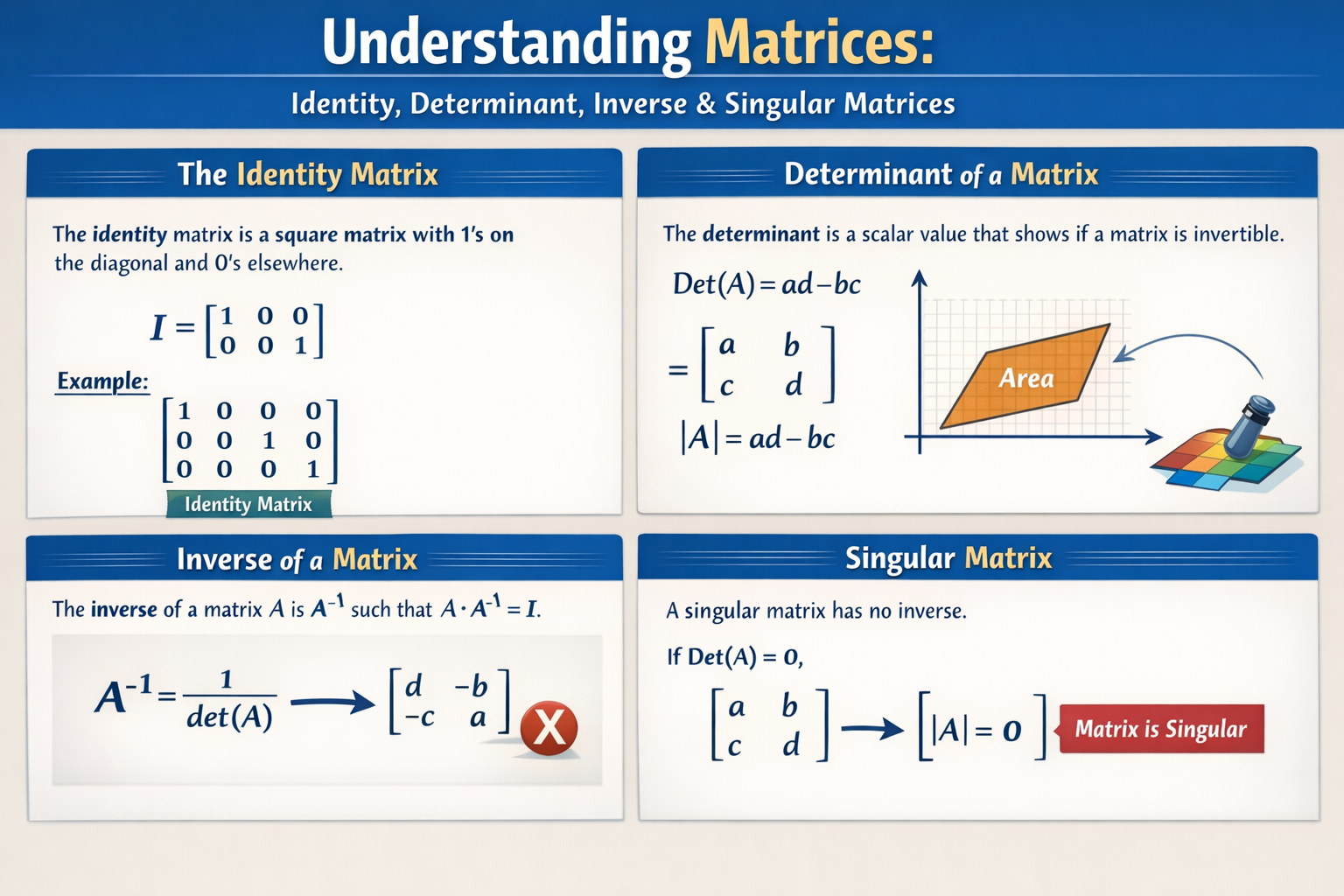
    Key matrices concepts include identity, determinant, inverse, and singular matrices, which help describe matrix properties and transformations.

    Matrices are important tools in mathematics and science. They are used to solve systems of equations, describe transformations, and model real-life problems such as economics, physics, and computer graphics.
    In this lesson, we will learn four important concepts related to square matrices:

    key concepts in matrices
    • Identity Matrix
    • Determinant of a Matrix
    • Inverse of a Matrix
    • Singular Matrix

    2. Identity Matrices

    Definition

    An identity matrix is a square matrix that has:

    • 1’s on the main diagonal
    • 0’s everywhere else

    It is similar to the number 1 in multiplication, because multiplying any matrix by the identity matrix gives the same matrix.


    Notation of matrices

    The identity matrix is denoted by I.

    2 × 2 Identity Matrix

    I2=[1001]I_2 = \begin{bmatrix} 1 & 0 \\ 0 & 1 \end{bmatrix}

    3 × 3 Identity Matrix

    I3​=​100​010​001​​


    Illustration

    Main diagonal →   1   1   1
    Other entries →   0   0   0
    

    Property

    A×I=I×A=AA \times I = I \times A = A


    3. Determinant of a Matrix

    Definition

    The determinant of a square matrix is a single number that tells us important information about the matrix, such as:

    • Whether the matrix has an inverse
    • Whether the system of equations has a unique solution
    • The scaling factor of a geometric transformation

    Determinant of a 2 × 2 Matrix

    For a matrix:A=[abcd]A = \begin{bmatrix} a & b \\ c & d \end{bmatrix}

    The determinant is:A=adbc|A| = ad – bc


    Example

    A=[3214]A = \begin{bmatrix} 3 & 2 \\ 1 & 4 \end{bmatrix}A=[31​24​] A=(3×4)(2×1)=122=10|A| = (3 \times 4) – (2 \times 1) = 12 – 2 = 10∣A∣=(3×4)−(2×1)=12−2=10


    The determinant represents area scaling:

    • If |A| = 2 → area doubles
    • If |A| = 0 → area collapses to a line

    4. Inverse of a Matrices

    Definition

    The inverse of a matrix A is another matrix A1A^{-1}A−1 such that:A×A1=IA \times A^{-1} = I


    Inverse of a 2 × 2 Matrix

    For:A=[abcd]A = \begin{bmatrix} a & b \\ c & d \end{bmatrix}A1=1adbc[dbca]A^{-1} = \frac{1}{ad – bc} \begin{bmatrix} d & -b \\ -c & a \end{bmatrix}

    Note: The inverse exists only if the determinant is not zero.


    Example

    A=[2153]A = \begin{bmatrix} 2 & 1 \\ 5 & 3 \end{bmatrix}

    Step 1: Find determinant:A=(2×3)(1×5)=65=1|A| = (2 \times 3) – (1 \times 5) = 6 – 5 = 1

    Step 2: Find inverse:A1=[3152]A^{-1} = \begin{bmatrix} 3 & -1 \\ -5 & 2 \end{bmatrix}


    Illustration

    Matrix A → changes a vector  
    Inverse A⁻¹ → returns it back to original
    

    5. Singular Matrix

    Definition

    A singular matrix is a matrix that has no inverse.

    $$\matrix{(a & b &c)}$$

    Condition

    A matrix is singular if: ∣A∣=0


    Example

    A=[2412]A = \begin{bmatrix} 2 & 4 \\ 1 & 2 \end{bmatrix}A=[21​42​] A=(2×2)(4×1)=44=0|A| = (2 \times 2) – (4 \times 1) = 4 – 4 = 0∣A∣=(2×2)−(4×1)=4−4=0

    Therefore, A is singular and cannot be inverted.


    Illustration

    Transformation squashes shape into a line → no way to reverse it
    
    
    $$\begin{pmatrix} a & b & c \\ d & e & f \\ g & h & i \end{pmatrix}$$

    6. Summary Table

    ConceptMeaningKey Condition
    Identity MatrixMatrix with 1’s on diagonalActs like number 1
    DeterminantSingle number describing matrix propertiesThe matrix is not a zero matrix
    Inverse MatrixMatrix that reverses AExists if A exists
    Singular MatrixMatrix without inverse

    7. Practice Questions

    Question 1

    Find the determinant of:A=[4726]A = \begin{bmatrix} 4 & 7 \\ 2 & 6 \end{bmatrix}

    Answer:
    A=(4×6)(7×2)=2414=10|A| = (4×6) − (7×2) = 24 − 14 = 10


    Question 2

    Write the 3 × 3 identity matrix.

    Answer:[100010001]\begin{bmatrix} 1 & 0 & 0 \\ 0 & 1 & 0 \\ 0 & 0 & 1 \end{bmatrix}


    Question 3

    Determine whether the matrix is singular:A=[1326]A = \begin{bmatrix} 1 & 3 \\ 2 & 6 \end{bmatrix}

    Answer:
    A=(1×6)(3×2)=66=0|A| = (1×6) − (3×2) = 6 − 6 = 0

    Matrix is singular.


    Question 4

    Find the inverse of:A=[1234]A = \begin{bmatrix} 1 & 2 \\ 3 & 4 \end{bmatrix}

    Answer:A=(1×4)(2×3)=46=2|A| = (1×4) − (2×3) = 4 − 6 = -2A1=12[4231]A^{-1} = \frac{1}{-2} \begin{bmatrix} 4 & -2 \\ -3 & 1 \end{bmatrix}


    8. Conclusion

    Understanding identity, determinant, inverse, and singular matrices is important in solving systems of equations, physics, engineering, and computer science. These concepts help us understand when a matrix can be reversed and how it transforms.

    Related Topics


  • Food and Nutrition

    Food and Nutrition is the study of what we eat and how it affects our body and health. Food provides us with nutrients such as carbohydrates, proteins, fats, vitamins, and minerals, which are essential for energy, growth, and maintaining good health. Proper nutrition helps the body function well, prevents diseases, and supports physical and mental development. Eating a balanced diet is important for staying healthy and active throughout life.

    Balanced Diet in food and nutrition

    A balanced diet is a diet that provides the body with all the essential nutrients it needs in the right amounts. It includes a variety of foods such as fruits, vegetables, grains, proteins, and dairy products. Eating a balanced diet helps maintain good health, supports growth and development, boosts energy, and reduces the risk of diseases. Making healthy food choices every day is important for overall well-being.

    Vitamins

    Here is vitamin charts

    A chart of food and nutrition showing sources of vitamins

    some sources of proteins

    Carbohydrates

    Carbohydrates include sugars and starches and are the predominant calorie source in most human diets, including grains, vegetables, fruits, dairy, legumes, and nuts. Below we have a chart of some sources of carbohydrates

    sources of carbohydrates in food and nutrition

    Related topics

  • INTRODUCTION TO PRESSURE

    INTRODUCTION TO PRESSURE

    Pressure is defined as the force acting perpendicularly per unit area.

    Pressure is a very important concept in physics and in everyday life. For example, when you press a thumbtack onto a notice board, the sharp tip makes it easy to push in because the force is concentrated on a very small area, creating high pressure. It would be more difficult to push a blunt pin through the same board. Consider the diagram below.

    illustrating how pressure acts on soft boards for a sharp pin and blunt pin

    We experience pressure all the time around us. When you stand on the ground, your weight exerts pressure on the floor.

    If you wear shoes with very thin heels, they exert more pressure on the ground than flat shoes because the area in contact with the ground is smaller.

    illustrating pressure exerted by low shoes and the sharp pointed shoes

    In the figure above, the sharp pointed heels dig deeper on soft ground because the weight of the body acts on a small area.

    Similarly, heavy vehicles use wide tires to spread their weight over a larger area and reduce pressure on the road. The pressure on each tire supports the weight of the vehicle. see the diagram below.

    heavy commercial vehicle exerting pressure on the ground

    Pressure also exists in liquids and gases. Air around us exerts atmospheric pressure, which is why drinking through a straw works—the pressure outside pushes the liquid up the straw. Water pressure increases as you go deeper in a swimming pool or the ocean because the weight of the water above pushes downwards. This helps us explain many real-life phenomena, such as why dams are thicker at the bottom, why submarines are built with strong walls, and how hydraulic machines work.

    By studying pressure, you will learn how force, area, and fluids interact, and how these ideas are applied in science, engineering, and daily life

    Calculating pressure

    pressure is the force applied on a surface divided by the area over which the force acts. This means that the same force can produce different effects depending on how spread out it is.

    $$pressure \ P = \frac{force(F)}{area(A)}$$

    The SI unit of pressure is derived from that of force and area.

    $$\text{SI unit of pressure} = \frac{\text{SI unit of force (Newtons)}}{\text{SI unit of area(square metres)}}$$
    $$SI unit of pressure = \frac{N}{m^2}= N/m^2 \ (Nm^{-2})$$

    The SI unit of pressure is thus newton per square metre(Nm-2).

    Newton per square metre is also know as the Pascal(Pa).

    1 Nm-2 = 1 Pa

    Some other units can be used to measure and express pressure. This is based on the height of liquid column that a given pressure can support.

    This units includes: mmHg, cmHg and atmosphere.

    mmHg means millimeter of mercury. It represents the height in millimeters of mercury that a given pressure can support.

    Mercury is widely used in pressure measurements because of it’s heavy density.

    Example problem 1

    A lady of mass 80kg stands on a ground. if the contact are of her shoes is 180cm2., determine the pressure she exerts on the ground. (take g= 10Nkg-1).

    solution

    $$pressure = \frac{force}{area}$$

    Force = weight of the lady = 80Kg x 10Nkg-1 = 800N

    are is given as 180 cm2 and we need to convert it to SI unit.

    therefore;

    $$area = \frac{180}{10000}=0.018 \ m^2$$

    hence

    $$pressure = \frac{800N}{0.018M^2} = \frac{800 \times 1000 N}{18m^2}$$ $$=44,444.44Nm^{-2}$$

    pressure Problem 2

    A ceramic block of mass 8kg is found to exert a pressure of 200Nm-2 on a surface. Determine it’s area that is contacting the surface. (take g = 10Nkg-1)

    solution to the pressure problem

    $$pressure = \frac{force}{area}$$

    Force = 8kg x 10Nkg-1 = 800N

    $$area = \frac{force}{pressure}$$

    hence

    $$area = \frac{800N}{200Nm^{-2}} = 4m^2$$

    Related topics


  • Exam Questions on floating and sinking

    Exam questions on floating and sinking covers varied concepts that determine what makes objects floats or sinks in fluids. Some of the most important concepts includes density, volume and mass.


    What Exam Questions on Floating and Sinking Test?

    1. Understanding of Key Concepts
      • Density: Ability to compare densities of objects and liquids to predict floating or sinking.
      • Buoyant Force / Upthrust: Understanding how an upward force acts on objects in a fluid.
      • Archimedes’ Principle: Knowing that the upward force equals the weight of the fluid displaced.
    2. Application of Theory
      • Predicting whether an object will float, sink, or partially submerge.
      • Explaining real-life examples (ships, icebergs, cork, boats).
      • Understanding how shape affects flotation, not just material.
    3. Numerical & Analytical Skills
      • Calculating density from mass and volume.
      • Determining the fraction of a floating object submerged.
      • Using formulas to relate buoyant force, weight, and displaced fluid.
    4. Observation & Reasoning
      • Explaining why certain objects behave differently in water.
      • Understanding the effect of changing variables (shape, volume, material).
      • Reasoning why an object rises if pushed slightly deeper in a fluid.
    5. Practical Awareness
      • Recognizing applications in real life (boats, ships, hot air balloons).
      • Relating theory to experiments (floating block, foil boat, cork in water).

    In short: Exam questions test conceptual understanding, problem-solving, reasoning, and practical application of the laws of flotation.

    here are some of the questions to test floating and sinking concepts

    1. (a) State Archimedes’ principle        (1mk)

    2. (b) Figure I0 shows a solid cylinder floating between two liquids A and B of  densities 0.8g/cm3 and 1.2g/cm3 respectively.  Half of its volume sinks in liquid B as shown. The cylinder has a diameter of 7cm and a length of 12cm. uses it to answer questions that follows.

    a floating log in an exam questions in floating and sinking

    Find;

    (i)  The volume of the liquid B displaced    (2mks)

    (ii)Upthrust on the cylinder due to liquid B         (3mks)

    (iii) Upthrust on the cylinder due to liquid A       (3mks)

     (iv) The mass of the cylinder                (2mks)

    Question 2

     (a) State the law of floatation.           (1 mk)

     ( b) A balloon of volume 2000m3 is filled with hydrogen of density 0.09Kg/m3. If the mass of the fabric is 100kg and that of the pilot is 75kg, what will be the greatest mass of equipment that can be carried by the balloon when operating in air of density 1.25kg/m3   (4 mks)

    Question 3

    (ii)        Fig. 6 shows a piece of cork held with a light thread attached to the bottom of

    a beaker. The beaker is filled with water.

     (I) Indicate and label on the diagram the forces acting on the cork.       (3 marks)

    (II)Write an expression showing the relationship between the forces.    (1 mark)

    III)      If the thread breaks name another force which will act on the cork. (1 mark)

    b)  A solid displaces 8.5 cm3 of liquid when floating on a certain liquid and 11.5 cm3 when fully submerged in the liquid. The density of the solid is 0.8 gcm3

    Determine:

    i) The upthrust on the solid when floating.      (3 marks)

    ii) The density of liquid.       (3mrks)

    iii) The upthrust on the solid when fully submerged  (3marks)

    Related topics