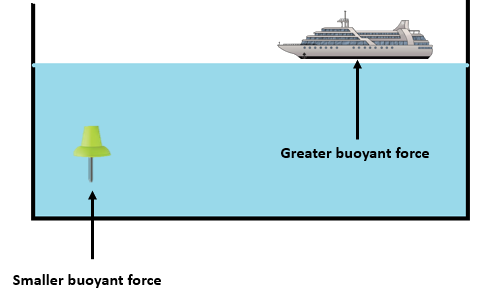
The law of floatation is considered a special case of the Archimedes’ principle. The law states that: A floationg object displaces its own weight of the fluid in which it floats.
To investigate the law of floatation
Materials/apparatus
Measuring cylinder
water
test-tube
sand
weighing balance
procedure
Half fill the measuring cylinder with water and record the level
Place a clean dry test tube into the cylinder and add some sand in it until it floats as shown. Record the new water level
3. Determine the volume of water displaced
4. Remove the test tube from the cylinder, dry it and determine it’s weight
5. Repeat the procedure five times, adding a little more sand each time and recording the volume of water displaced. Record the results in a table shown.
Weight of sand and testtube (N)
Volume of water displaced(cm3)
Mass of water displaced(kg)
Weight of water displaced(N)
observations and conclusions
The test tube sinks deeper every time some some is added
Weight of the test tube and it’s content is equal to the weight of water displaced
Experiment 2
Materials Needed:
Beaker or a transparent container (1–2 L)
Water
Objects of different densities and shapes (wood, plastic, metal, cork)
Spring balance (optional, for measuring weight)
Measuring cylinder or scale
Graph paper (for recording observations)
Ruler
Procedure:
Preparation:
Fill the beaker with water about 3/4 full.
Record the water level.
Observation of Floating and Sinking:
Gently place each object in water one by one.
Observe whether it floats, sinks, or partially floats.
Measurement (Optional for Quantitative Study):
Measure the weight of each object using a spring balance.
Observe how much of the object is submerged when it floats.
Record the depth of submersion.
Changing Variables (Shape & Density):
Take a piece of aluminum foil and make it into a flat sheet, then into a boat shape.
Place it in water and observe whether the shape affects flotation.
Record Observations:
Note which objects float and which sink.
For floating objects, note the fraction submerged.
Variables:
Independent Variable: Type of object (density, material, shape)
Dependent Variable: Whether the object floats or sinks, depth of submersion
Controlled Variables: Volume of water, temperature of water, same container
Expected Observations:
Objects denser than water will sink (e.g., metals like iron).
Objects less dense than water will float (e.g., cork, wood).
Changing the shape of an object can make it float even if it is denser than water (e.g., aluminum foil boat) because it displaces more water.
Conclusion:
An object floats if the upthrust (buoyant force) is equal to its weight hence verifying the law of floatation.
The fraction of the object submerged depends on its density relative to water.
The shape can influence flotation by changing how much water is displaced.
Example problem
A ship of mass 250000kg floats on flesh water. If the ship enters the sea, determine the load that must be added to it so that it displaces the same volume of water as before. (Take density of fresh water as 1000Kgm-3 and that of sea water as 1025kgm-3)
solution
weight of the ship = 250000kg x 10Nkg-1 = 25000000 N
from the law of floatation: weight of flesh water displaced = weight of the ship
$$\text{Mass of water displaced} = \frac{25000000}{10Nkg^{-1}}=250000kg$$
$$\text{Volume of flesh water displaced} = \frac{250000kg}{1000kgm^{-3}}=250m^3$$
Volume of sea water displaced when more load is added = 250m3
mass of sea water displaced = 250m3 x 1025kgm3 = 256,250kg
weight of the sea water displaced = 2,562,500 N
Extra load needed = weight of sea water to be displaced – weight of flesh water displaced
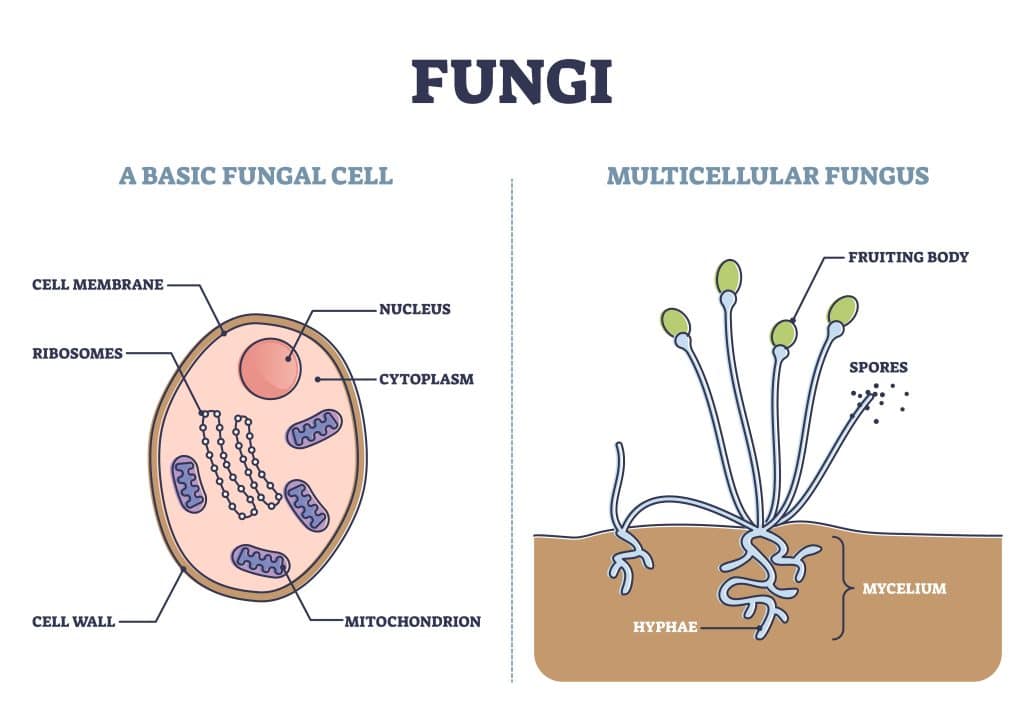
Fungi are a unique group of living organisms that are separate from plants, animals, and bacteria. They include molds, yeasts, and mushrooms. Unlike plants, fungi do not make their own food through photosynthesis. Instead, they absorb nutrients from organic material around them. Their cell walls are made of chitin, the same substance found in insect shells, which is one feature that distinguishes them from plants.
In terms of biology, fungi usually grow as long, thread-like structures called hyphae, which form a network known as mycelium. They reproduce both sexually and asexually, most commonly by producing spores that can spread through air, water, or living organisms. These spores allow fungi to survive in harsh conditions and colonize new environments. Some fungi, like yeast, are unicellular, while others are multicellular and can grow quite large.
Ecologically, fungi play a crucial role in maintaining balance in ecosystems. They are primary decomposers, breaking down dead plants and animals and recycling nutrients back into the soil. Many fungi also form symbiotic relationships. For example, mycorrhizal fungi live in association with plant roots and help plants absorb water and minerals, while lichens are partnerships between fungi and algae or cyanobacteria that can survive in extreme environments.
Fungi are important to human health in both positive and negative ways. Some fungi cause diseases, such as athlete’s foot or more serious infections in people with weak immune systems. However, fungi are also extremely beneficial. Penicillin, one of the first and most important antibiotics, was derived from a fungus. Other fungi are used to produce medicines, enzymes, and vitamins.
In food and industry, fungi are widely used and highly valuable. Edible mushrooms are a nutritious food source, providing protein, vitamins, and minerals. Yeast is essential in baking and brewing, as it ferments sugars to produce carbon dioxide and alcohol. Fungi are also involved in making cheese, soy sauce, and other fermented foods. Overall, fungi are essential organisms that support ecosystems, human health, and many everyday products.
The basic structural unit of most fungi is the hypha, a thin, thread-like filament. Hyphae grow and branch to form a complex network called the mycelium, which is usually hidden within soil, food, or other organic material. The cell walls of fungi are made of chitin, providing strength and protection. Some fungi, such as yeast, are unicellular, while others are multicellular and may form visible structures like mushrooms, which are actually reproductive parts.
Reproduction
Fungi reproduce in both asexual and sexual ways. Asexual reproduction is more common and occurs through methods such as spore formation, budding (in yeast), or fragmentation of hyphae. Sexual reproduction involves the fusion of specialized cells from two compatible fungi, followed by genetic recombination. In both cases, fungi usually produce spores, which are lightweight, easily dispersed, and capable of surviving unfavorable conditions.
Life Cycle
The fungal life cycle typically begins when a spore lands in a suitable environment and germinates into hyphae. These hyphae grow and form a mycelium that absorbs nutrients. Under favorable conditions, the mycelium produces reproductive structures that release new spores, continuing the cycle. In fungi that reproduce sexually, the life cycle includes stages of plasmogamy (fusion of cytoplasm), karyogamy (fusion of nuclei), and meiosis, leading to genetically diverse spores.
Fungi play a vital role in ecosystems by keeping nutrients circulating through the environment. They are key regulators of ecological balance because they break down complex organic materials that most other organisms cannot digest. Without fungi, dead plants and animals would accumulate, and essential nutrients such as carbon, nitrogen, and phosphorus would remain locked away instead of being reused by living organisms.
Fungi role in ecosystems
One of the most important ecological roles of fungi is decomposition. As decomposers, fungi release enzymes that break down dead leaves, wood, and animal remains into simpler substances. These nutrients are then returned to the soil, where they can be absorbed by plants and other organisms. Fungi are especially important in breaking down tough materials like cellulose and lignin found in plant cell walls, making them indispensable in forest and soil ecosystems.
Fungi also form symbiotic relationships with other organisms, meaning both partners benefit. A major example is mycorrhizae, a partnership between fungi and plant roots. The fungal hyphae extend far into the soil, greatly increasing the plant’s ability to absorb water and minerals such as phosphorus. In return, the plant provides the fungus with sugars produced during photosynthesis. This relationship improves plant growth, soil structure, and overall ecosystem productivity.
Another important symbiotic relationship is seen in lichens, which are formed by a fungus living together with an alga or cyanobacterium. The fungus provides protection, moisture, and support, while the alga or cyanobacterium produces food through photosynthesis. Lichens can survive in extreme environments such as bare rock, deserts, and polar regions, and they are often among the first organisms to colonize new or disturbed areas, helping to start soil formation and ecological succession.
Overall, through decomposition and symbiosis, fungi are essential for ecosystem health, stability, and sustainability.
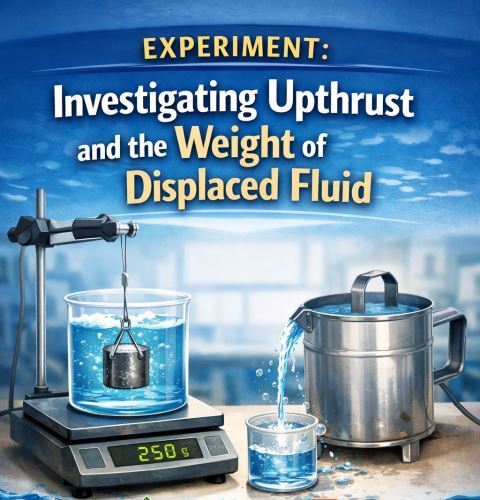
Upthrust is a force that acts on an object when it is placed in a fluid, causing the object to experience an apparent loss of weight. This experiment investigates the relationship between upthrust and the weight of the fluid displaced by an object. By observing how objects behave when immersed in a liquid, the experiment helps to verify Archimedes’ principle, which states that the upthrust on an object is equal to the weight of the fluid it displaces.
Objectives
To show that the upthrust (buoyant force) acting on a submerged object is equal to the weight of the fluid displaced by the object — in line with Archimedes’ principle.
To observe displacement of water
Apparatus
Spring balance
String
Overflow can (Eureka can)
Beaker or measuring container
Water
Solid object (e.g., metal block or stone)
Procedure
Fill the overflow can (Eureka can) with water until it begins to pour out. Stop when it stops dripping.
Weigh the object in air and record as W₁.
Lower the object fully into the water and weigh it again — record this as W₂.
The water that overflowed into the beaker is the displaced fluid. Weigh this water.
Calculate:
Upthrust = W₁ − W₂
Weight of displaced fluid = (weight of beaker + displaced water) − (weight of empty beaker)
Observations Table
Measurement
Symbol
Value
Weight in air
W₁
…
Weight in water
W₂
…
Upthrust (calculated)
W₁ − W₂
…
Weight of displaced fluid
…
…
Weighing the Object in Air
Attach the object to a spring balance and record its weight in air. see the diagram below
This shows the true weight before immersion.
1. Attach the object to a spring balance and record its weight in air. 2. This shows the true weight before immersion.
Immersing the Object in Water
Gently lower the object into the overflow can so it’s fully submerged but not touching the sides.
Collection container catches water that overflows — this is the displaced fluid. Read and record the apparent weight shown on the spring balance (it will be less than the weight in air).
Conclusions
You should find that the upthrust (loss of weight) is equal to the weight of the displaced fluid.
This confirms Archimedes’ principle: Upthrust on an immersed object equals the weight of the fluid it displaces.
Floating and sinking describe how objects behave when placed in a fluid such as water or air. Whether an object floats or sinks depends on the balance between its weight and the upthrust (buoyant force) exerted by the fluid. Objects that float are supported by the fluid because the upthrust is equal to or greater than their weight, while objects sink when their weight is greater than the upthrust. This concept is closely related to density and helps explain many everyday phenomena, from ships staying afloat to stones sinking in water.
The Archimedes’ principle states that; When a body is partially or totally immersed in a fluid, it experiences an upthrust force equal to the weight of the fluid displaced.
The law of flotation
It is a special case of the Archimedes’ Principle which states that: A floating object displaces it’s own weight of the fluid in which it is floating.
Explaining upthrust force from the Archimedes’ principle
Upthrust force, also known as buoyant force, is the upward force exerted by a fluid (liquid or gas) on an object immersed in it. This force acts vertically upward and opposes the weight of the object. If the upthrust is greater than the object’s weight, the object floats; if it is less, the object sinks. Thus, Archimedes’ principle explains why objects behave differently in fluids depending on the amount and weight of fluid they displace.
Objects will weigh less in water than in air. Take a spring balance and hang some mass on it. Determine the weight of the mass and then push the mass up slightly with your hand. What have u observed?
When you place some upward force on a mass hanging on the spring, it’s weight is seemed to reduce as observed by lesser leading of the spring balance.
When you apply a force upward on the object hanging on a spring balance, you are providing some force that is acting opposite to the weight of the object. Weight is always acting downward on a straight line that is directed towards the center of the earth.
When you push the object upward, you are reduce the overall resultant downward force by providing some force acting opposite to the weight.
From the law of addition of forces, when two forces are acting in opposite direction on the same object, then one force is considered positive force and the other one taken as negative force . The total resultant force acting on the object is the algebraic sum of the forces acting on that object Consider the setup below that shows some weight acting on an object hanging freely on air.
Spring balance measuring some weight
We consider the force acting on the object which is it’s weight as W and any force applied upward as U as shown.
Illustrating forces acting on an object hanging on air
The resultant force will be given as W’=W-U. Where W’ represents the reduced weight.
If U is greater than W’, then the object will accelerates upward, otherwise it will accelerates downward with reduced force.
The downward acceleration force is balancing with tensional forces on the spring causing some extension, hence the object remains on the spring balance but causing it to extend in length.
The Archimedes’ principle, Upthrust Force
When an object is immersed in a fluid, the upward forces on the object are provided by pressure in the fluid. That is why objects weighs less in water because some weight of the object is being cancelled out by the upward forces in water. This upward forces produced by fluid on an object is known as the upthrust force. It is the same force that causes object to float in water.
However, it is important to note that, for heavier objects falling in air, the upthrust by air is soo small such that it cannot be notices. We say that upthrust of air on an object is negligible.
showing upthrust with paper and stone
If you release a piece of paper and a stone from some distance above the ground, you will notice that the stone reaches the ground faster than the paper. This is because upthrust force on paper is comparable to that of paper, because a piece of paper has very small weight. However, the stone weight is much more than the upthrust that can be provided by paper hence the total resultant downward forces is larger than that of paper hence causing more acceleration downward.
Later on, we will see that upthrust fall is a characteristic of both volume of the object and density of the fluid.
cause of upthrust
Consider a cylindrical solid of cross-section area A which is totally immersed in a fluid of density ρ as shown.
The pressure due to liquid column is usually given by P=ρgh.
Pressure at the top of the solid will be given by, PT = h1ρg.
Where h1 is the height of the liquid column above the top of the object.
Pressure at the lower end of the object will be given by
Pb=h2ρg where h2 is the height of the liquid above the lover surface of the cylinder .
The pressure at the top of the cylinder will provide downward force exerted by the liquid up on the object.
From the pressure laws, F=pressure P x Area A.
i.e F=PA.
Taking the area of the cylinder at the top, the force from the liquid acting on that surface is Given by F=PT x A=h1ρgA.
Similarly, pressure at the bottom is given as F=PB x A=h2ρgA.
The total resultant upwardward force F is this given as
F=F2-F1
Hence F=h2ρgA-h1ρgA
Factoring out the common factors: F=ρgA (h2-h1)
Let h be the difference between liquid column on top and the one at bottom h2 such that h=h2-h1
Hence F=ρgAh
But Volume is always given by V=Ah
The resultant force F is the upthrust force U and will thus be expressed as.
F=U=Aρpg=pgV
where V is the volume of the liquid displaced.
Mass of the liquid is usually given by density x volume. Hence mass m of liquid displaced will be given by m=Ahρ
Weight is usually given as Weight W=mg
Hence weight of liquid displaced will be W=U=Ahρg which represents the upthrust force we calculated earlier. This confirms the Archimedes’ principle that upthrust force is equal to the weight of the fluid it displaces.
From our mathematical arguments, it should be easy to see that Magnitude of the upthrust force is equal a function of volume of the object and density of the liquid considering. From the Archimedes’ principle, we can solve many problems that involves floating and sinking.
Example problem 1
1. A wooden block of mass 375g and density 750kgm-3 is held under water by tying it to the bottom of the container with a light thread as in the diagram below.
Determine the tension in the thread.
(Density of water e = 1000kgm-3 )
solution:
upthrust = weight of the water displaced
$$Volume = \frac{Mass}{Volume} = 500cm^3$$
$$mass of water = 500cm^3 \times 1.0gcm^{-3}$$
$$ = 500g = 0.5kg$$
weight displaced = 0.5Kg x 10 = 5.0N
Upthrust exerted by water = 5.0N
Weight of the block = 3.75N
Tension = upthrust – weight
Tension = (5.0N – 3.75N) = 1.25 N
(c) A sphere suspended from a spring balance in air has its weight recorded as 6N when submerged half-way in water, the spring balance reads 4.2 N. Calculate the volume of the sphere.
hence volume of the stone will be given as 0.0004m3 or 4.0 x 10⁻⁴m3
(b) we finds the density of the stone given it’s weight and having calculated it’s volume
$$\text{mass of the stone} = \frac{30.0N}{10Nkg^{-1}}$$
mass of the stone = 30.0N/10Nkg-1 = 3.0Kg
$$\text{Density of the stone}=\frac{mass of the stone}{volume of the stone}$$
$$ =\frac{3.0kg}{4.0 \times 10^{-4} }= 0.75 \times 10^{4}kgm^{-3} = 7500kgm^{-3}$$
Exam practice Question
(a) i) State the law of flotation. (1 mark)
(ii) Fig. 6 shows a piece of cork held with a light thread attached to the bottom of
a beaker. The beaker is filled with water.
(I) Indicate and label on the diagram the forces acting on the cork. (3 marks)
II) Write an expression showing the relationship between the forces. (1 mark)
……………………………………………………………………………………………………
……………………………………………………………………………………………………
III) If the thread breaks name another force which will act on the cork. (1 mark)
……………………………………………………………………………………………………
……………………………………………………………………………………………………
b) A solid displaces 8.5 cm3 of liquid when floating on a certain liquid and 11.5 cm3 when
fully submerged in the liquid. The density of the solid is 0.8 gcm3
Determine:
i) The upthrust on the solid when floating. (3 marks)
………………………………………………………………………………………………….…
……………………………………………………………………………………………………
……………………………………………………………………………………………………
ii) The density of liquid. (3mrks)
………………………………………………………………………………………………….…
……………………………………………………………………………………………………
……………………………………………………………………………………………………
iii) The upthrust on the solid when fully submerged (3 marks)
The gradient of a line, also known as its slope, is a measure of its steepness. It describes the ratio of the vertical change to the horizontal change between any two points on the line. consider the diagram below:
Line A is closer to the vertical axis but farthest from the horizontal axis. Line A is said to be steepest among the lines A, B, C, D because it is the closest to the vertical line. The steepness of a line is it’s gradient.
consider yourself traversing through the lines horizontally via line Q and vertically via P.
You will arrive at A first while travelling horizontally but while moving vertically you will arrive at D first. D is closer to horizontal position but far from vertical position. The lines illustrated above are moving in two dimensions: Horizontal and vertical dimensions.
consider yourself moving along line B; you will realize that, you have changed horizontal and vertical distance in the movement.
As you move along B, you will have covered distance PY vertically and distance QY horizontally. The ratio of vertical distance covered to the horizontal distance covered gives the gradient(steepness of a line).
$$gradient = \frac{PY}{QY}$$
If vertical distance covered is larger than the horizontal distance, the line is said to have a steep gradient.
We can get gradient of a line by finding vertical and horizontal change from any two arbitrary points on a line.
Let us take any two points on a Cartesian plane shown above, x1 corresponds to y1 and x2 corresponds to y2.
the horizontal distance covered between P and Q = x1 -x2
the vertical distance covered between P and Q = y1 – y2
Electronics Exam Questions tests the broad areas of the field. Among the concepts tested by most of examiners includes, including basic concepts, analog circuits, and digital electronics. The subtopics to consider includes:
Ohm’s Law and basic circuits
Capacitors and inductors
Diodes and rectifiers
Transistors (BJT and FET)
Operational amplifiers (Op-Amps)
Logic gates and combinational circuits
Sequential logic circuits and number systems
Power supplies and regulation
circuit combinations
Below are some questions that are asked in examinations
(a) Distinguish between semiconductor and conductors (2mks)
(d) Figure 8 shows a puzzle box containing two lamps and other simple components connected so that, when terminal T1 is connected to the positive pole of a cell, Lamp L1 alone lights but when terminal T2 is connected to the positive lamp L2 alone lights.
Sketch a possible arrangement including lamps L1 and L2 and a set of diodes. (2mks)
2. (a) i) Explain how the resistance of semi-conductors and metal conductors are affected by temperature rise. (2mks) ……………………………………………………………………………………………………………………………………………………………………………………………………………………………………………………………………………………………………………………………………………………………………………………………………………………………………………………………………………………………………………………………………………………………
(b) ii) Sketch a forward bias characteristic of a P – N junction diode in the axis below.(1 mark)
3. a) A transformer is connected to a d.c source. The secondary coil is connected to a centre zero galvanometer.
State and explain the observation made on the galvanometer. (2 mks)
b) State Lenz’s law. (1 mark)
(i) Distinguish between semi conductors and conductors. (2 mks)
(ii) Give one example of a semi conductor and one example for a conductor. (2 mks)
(iii) What is meant by donor impurity in a semi conductor. (1 mk)
(iv) Draw a circuit diagram including a cell, a diode and a resistor in the reverse biased mode. (1 mk)
(v) In the circuit in figure 12 below, when the switch is closed, the voltmeter shows a reading. When the cell terminals are reversed and the switch is closed the voltmeter reading is zero.
The Intrinsic semiconductors are extremely pure semiconductor. A good example of such elements includes silicon(Si), germanium(Ge),Selenium(Se) and Tellurium (𝑇𝑒). These semiconductors have their outmost shell occupied by 4 electrons .
Their outer most electrons combines covalently with electrons from their neighboring atoms to form a crystal. each atom is hence surrounded by 4 other atoms.
Silicon atoms bond covalently by sharing their four valence electrons with four other silicon atoms, forming a stable, three-dimensional tetrahedral network. Each silicon atom is bonded to four neighbors, and each bond consists of a shared pair of electrons, which helps the silicon atoms achieve a stable outer shell configuration. The figure below illustrates formation of silicon structure.
At absolute zero temperature(-273.16K), the semiconductor crystal is an insulator. At room temperature, some electrons in the valence band gains enough energy to move to the conduction band leaving behind holes in the valence band. This movement makes the element a conductor. At higher temperatures, more electron are moved to the conduction bands and more holes are created. This increases the conductivity of the semiconductor material.
In an intrinsic semiconductor, the number of electrons equals the number of holes.
charge carriers
The electrons and the holes are referred to as the charge carriers. Small quantities of impurities may be added to an intrinsic semiconductors to enhance it’s conductivity on a process known as doping. An intrinsic semiconductor to which impurities have been added to enhance conductivity is referred to as an extrinsic semiconductor. Extrinsic semiconductors can be classified as either n-type or p-type semi-conductor. Depending on the type of semi-conductor created from doping, we develops majority and minority charge carriers.
Majority and minority charge carriers are electrons and holes that carry electric current in a semiconductor. Majority charge carriers are the most abundant type while minority charge carriers are the lesser in number.
The n-type semiconductors
This is formed by doping an intrinsic semiconductor with a pentavalent atoms. A pentavalent atom is an atom that has five valence electrons in its outermost shell. These elements belong to Group 15 of the periodic table, also known as the pnictogens. Pentavalent atoms are primarily found in the nitrogen group (Group 15) of the periodic table and include: Bismuth (Bi),Nitrogen (N),Phosphorus (P),Arsenic (As)and Antimony (Sb).
When a pentavalent atoms is introduced into the impure semiconductor,4 of it’s 5 electrons forms a covalent bond with 4 neighboring atoms of the intrinsic semiconductor.
This causes to be a free electron that is not bound to an atom. This free electron can thus be used for electrical conductivity.
Note: n-type semiconductor is electrically neutral since the total number of electrons is equal to the total number of protons in the material.
The atom added to the intrinsic semiconductor is referred to as the donor atom. For pentavalent atoms, they can also be referred to as the n-type impurity.
The P-type semiconductor
This is a type of semiconductor obtained by doping an intrinsic semiconductors with trivalent atoms.
Trivalent atoms are atoms that have a valence of three, meaning they have three electrons in their outermost shell or can form three covalent bonds. Examples include boron (B), aluminum (Al), and nitrogen (N) and Indium.
As an example, consider a boron atom being injected into silicon atom. Because boron has three electrons in it’s outer shell, it will have one electron less to complete the bonding when fitting into the silicon lattice. There will thus be a vacant place due to the missing electron which is a hole. The silicon crystal thus becomes an extrinsic semiconductor with holes as the majority charge carriers. The resulting semiconductor is referred to as the P-type semiconductor because the majority charge carriers are holes with an effective positive charge.
Illustrating hole as the majority charge carrier in a p-type semiconductor
Germanium doped with boron to form p-type semiconductor
A trivalent atom that completes bonding in an intrinsic semiconductor with one atom less to create a hole is known as an acceptor atom.
Electrons are minority charge carriers while holes are the majority charge carriers in a p-type extrinsic semiconductor.
The p-type semiconductor however, is not positively charged but electrically neutral. This is because the impurity introduces equal number of electrons and protons found in the nucleus.
Fixed ions
In P-type semiconductor holes are the majority charge carriers. As holes moves away from the parent atom, they make the atom to be a negative ion which is fixed in the crystal. This ion does not take part in conduction. electrons which are thermally generated exists as the minority charge carriers. See the illustration below.
In the n-type semiconductor, an electron moving away from a parent atom generates a fixed positive ion. The holes are thermally generated while electrons are as a result of doping. The figure below shows the fixed ion from the n-type semiconductor.
Electronics is the branch of physics and engineering that deals with the behavior and control of electrons to process information or control systems. The technology is based on circuits made of components that manipulate electrical signals, and it is the foundation of almost all modern devices, from consumer gadgets to industrial machinery.
Development of electronics has resulted to manufacture of appliances such as television sets, computer motherboards, radio-receivers, hi-fi systems, smart watches, etc. modern electronics devices are based on understanding properties of conducting materials.
Understanding of electricity and conductivity of various materials has enabled us develop electronic components such as diodes and transistors. These are very useful in controlling of electric currents.
Materials used to construct electronic components maybe classified as conductors, insulators and semi conductors. The differences in electrical properties among these materials depends on the force that holds the outermost electrons to the atoms of the material.
Conductors
This are materials with low electrical resistance. They carries electrical charges in them from one point to another. Their conductivity is facilitated by their internal structure.
The outermost electrons of the atoms in a conductor are loosely held such that they becomes detached to move freely through the material. The movement of these electrons facilitates conduction of current.
Resistance of current in metal is as a result of collisions between the freely moving electrons and the vibration of atoms. Increase of temperature increases the speed of vibrating atoms. The increase vibration increases the frequency of vibration. This increases the resistance of conductors hence resistance in metal increases with increase in their temperature. examples of conductors includes iron, copper, aluminium, lead, brass etc.
Insulators
They are materials with very high electrical resistance. Their outmost electrons are held tightly to their atoms and so they do not have free electrons. Insulators do not conduct electric current nor heat as they do not have free electrons to do so. However, insulators are very useful as they help in handling of materials that are carrying current or at high temperatures. Examples of insulators includes rubber, plastics , ceramics and wood.
semiconductors
They are the most useful as far as the electronics is concerned. These are materials with conductivity that is between that of conductors and that of insulators. Semiconductors allows the flow of electric current or heat under certain circumstances only. pure semiconductors have four electrons in their atoms outermost shell. They electrons are tightly held to the atom but the force that hold them is less compared to that in the insulators. However, the force is stronger than that of conductors.
At room temperature, the random atomic vibrations associated with the heat energy gives a small fraction of these electrons sufficient energy to escape from their bond and become free electrons. This causes them to be able to conduct electric current.
The escape of electrons from the structural bond leaves a gap where it was occupying.
The gap left by the escaped electron is known as the hole. Holes can hop from one atom to the other and responds to electrical voltage just like the electrons. However, holes carries positive charge while electrons carries negative charge. The figure below illustrates the movement of a hole during electrical conductivity of a semi-conductor.
Holes are the bonds between atoms where an electron has left the atom. Holes hop from atom to atom as shown:
As the temperature of a semiconductor is raised, the bond that holds electrons is weakened. More electrons are able to escape and so the number of free electrons and holes increases. This means that the electrical resistance of semiconductor decreases with increase of temperature. The reverse in conductivity is also true when temperature reduces.
The conduction band theory
In an atom, each electron has a specified amount of energy it posses. Each electron is thus said to exist in a certain energy level.
According to the energy-band theory, when two or more atoms are brought close to each other, the energy levels split into smaller energy levels called bands. This results from interaction of both electric and magnetic fields of the electrons as they revolve in their energy levels. The energy bands are illustrated below:
In solids, because atoms are close together, energy levels merge into bands of energy. Between the bands are gaps that represents energies electrons cannot have. It is the width of the gap that determines conductivity of the material.
The bands have gaps between them which represents energies electrons cannot have.
conduction band
The conduction band is the lowest energy band in a solid where electrons can move freely and conduct electricity. It is located above valence band and is typically empty or partially filled. When electrons gain enough energy, they can jump from the valence band to the conduction band.
Electrons in the conduction band can move freely through the material under the influence of an electric current.
The outermost electrons of the atoms occupies the conduction band and are not bounded exclusively to any one atom. The slightest potential difference across a metal will make the electrons flow. This makes metal good conductors of electric current and where current flow is proportional to the potential difference across the metal. Conductors have no energy gaps such that conduction band and the valence band overlaps. see the figure below:
valence band
The valence band is the highest energy band in a solid that is filled with electrons at absolute zero temperature. These electrons, called valence electrons, are the outermost electrons of the atoms and are responsible for chemical bonding. In valence band, electrons are not free to move.
Energy bands in semi-conductors
In semiconductors, there exists an energy gap between the valence band and the conduction band. An electron in a covalent bond between two atoms must receive extra energy in order to be lifted into the conduction band.
A significant number of electrons receives enough energy from thermal vibrations to be excited into the conduction band. This is because the gap allows.
When temperature rises, it increases the chance of electrons moving from valence band to the conduction band. Therefore electrical resistance of a semiconductor reduces with increase of temperature.
Energy bands in insulators
Insulators are as important in electronics as the conductors and semiconductors. The gap below the conduction band is very large and normal thermal vibrations are not sufficient to excite electrons into the conduction band. see the figure below.
There will never be any electron in the conduction band as the electrons remains bonded to their individual atoms hence cannot move as current. Temperature will not increase conductivity as there can never be found enough energy to excite an electron into the conduction band.
Contains information related to marketing campaigns of the user. These are shared with Google AdWords / Google Ads when the Google Ads and Google Analytics accounts are linked together.
90 days
__utma
ID used to identify users and sessions
2 years after last activity
__utmt
Used to monitor number of Google Analytics server requests
10 minutes
__utmb
Used to distinguish new sessions and visits. This cookie is set when the GA.js javascript library is loaded and there is no existing __utmb cookie. The cookie is updated every time data is sent to the Google Analytics server.
30 minutes after last activity
__utmc
Used only with old Urchin versions of Google Analytics and not with GA.js. Was used to distinguish between new sessions and visits at the end of a session.
End of session (browser)
__utmz
Contains information about the traffic source or campaign that directed user to the website. The cookie is set when the GA.js javascript is loaded and updated when data is sent to the Google Anaytics server
6 months after last activity
__utmv
Contains custom information set by the web developer via the _setCustomVar method in Google Analytics. This cookie is updated every time new data is sent to the Google Analytics server.
2 years after last activity
__utmx
Used to determine whether a user is included in an A / B or Multivariate test.
18 months
_ga
ID used to identify users
2 years
_gali
Used by Google Analytics to determine which links on a page are being clicked
30 seconds
_ga_
ID used to identify users
2 years
_gid
ID used to identify users for 24 hours after last activity
24 hours
_gat
Used to monitor number of Google Analytics server requests when using Google Tag Manager