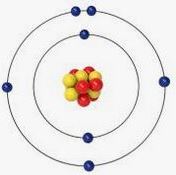
The decay law is an exponential decay law that describes the spontaneous transformation of unstable atomic nuclei into more stable ones by emitting radiation.
The decay law states that the rate of disintegration at a give time is directly proportional to the number of nuclides present at that time.
Radioactive decay is described as a spontaneous, random process in which the nuclide that will disintegrate next cannot be predicted. Time and chances determines the next nuclide to decay.
let N be the number of nuclides present at the current time.
then rate of change of N (dN) in respect to change of time(dt) is directly proportional to the existing number of nuclides available. That is:
$$\frac{dN}{dt} ∝ -N$$
Introducing a constant of the above proportionality which is known as the decay constant we get: λ
$$\frac{dN}{dt} = -λN$$
The negative sign in the equation above indicates that the number of nuclides N decreases with increase of time.
$$\frac{dN}{dt} \text{is referred to as the activity of the sample}$$
Half-life in radioactivity
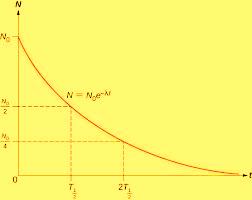
Half life is the time taken for half of nuclides present in a radioactive sample to decay to half of their total number. For example if there 10000 nuclides in a sample, the time taken for them to reduce to 5000 due to radioactivity is the half life of the involved element.
It can be shown that the number of nuclides remaining undecayed , N, after a period of time T will be given by:
$$N = N_0 (\frac{1}{2})^{\frac{T}{t}}$$
The number of nuclides that remains after every half life can be plotted against a number of half lives to have the shape shown:
Example problems of decay law
The half life of a certain radioactive element is 16 years. What fraction of the element with have decayed after: (a) 48 years, (b) 80 years
solution
The amount remaining after T years will be given by:
from the above expression, it looks like we could easily get the summation of n numbers of items in an arithmetic series by simply adding two terms vertically. When arranged in reverse order, multiply by n then divide by two to get the sum.
From the above observations, we can easily add the the last term and the first term multiply by number of terms to get the sum x 2.
in other words; if there there are n terms in a series, if we have a term in m position, then am+a[n-(m-1)] = will always give the same value.
in the above series, let mth b the 7th term, then [n-(m-1)]th will be (10-7)th term = 3rd term.
consider the series s10 =5+9+13+17+21+25+29+33+37+41= 230
The 7th term = 29 while [n-(m-1)]th = [10-(7-1)]th term = [10-6]th term = 4th term.
The term in the series will be equal to 17.
29+17 = 46
To have a general expression, let us consider the general arithmetic series:
General expression of arithmetic series
sn = a+(a+d)+(a+2d)+(a+3d)+……..+[a+(n-3)d][a+(n-2)d]+[a+(n-1)d]
When radioactive materials undergoes radioactive decay, they produce radiations that exhibits different properties.
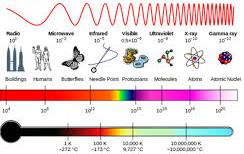
There are two broad categories of radiations: Ionizing radiation, which has enough energy to remove electrons from atoms and includes alpha particles, beta particles, neutrons, X-rays, and gamma rays. Non-ionizing radiation, which does not have enough energy to do so and includes radio waves, microwaves, infrared, and visible light. Ionizing radiation is further categorized into particle radiation (alpha, beta, neutrons) and electromagnetic radiation (X-rays, gamma rays).
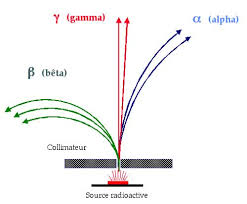
One of the methods we use to distinguish among different radiations is how they behave inside magnetic and electric field. Figure below how a radiations from a radium source are deflected by magnetic field.
The radium source is placed in a thick lead box with a small opening. When a strong magnetic field is introduced perpendicular to the path of radiations, some are deflected . Using Fleming’s left-hand rule, we show that Radiation P is positively charged, R is negatively charged while Q carries no charge.
The positively charged radiation is called the alpha(α) radiations. The negatively charged radiations are referred to as beta (β) radiations.
The uncharged radiations are known as the gamma(γ) radiations.
From the diagram above, alpha particles are deflected the least suggesting that they are the heaviest. Alpha particles are basically helium nucleus
The energy of radiations is the energy carried by electromagnetic waves or particle radiation. It is directly proportional to the radiation’s frequency and inversely proportional to its wavelength. For electromagnetic radiation, this energy can be calculated using Planck’s equation, E = hf, where E is energy, h is Planck’s constant, and f is frequency.
The energy carried by a radiation determines the maximum kinetic energy gained by a photoelectron after it’s extracted to the metal surface.
A circuit shown can be used to investigate the relationship between the frequency of the radiation and the kinetic energy of the photoelectrons.
Frequency is varied using different color filters. for each color filter, the potential difference is varied by moving the jockey between X and Y until no current is registered. The battery is connected in such that it opposes the ejection of electrons by attracting the ejected photoelectrons back to the cathode. The voltmeter reading gives the stopping potential for a given frequency.
Different color filters will allow different frequencies to fall on cathode. This determines the energy of the photoelectrons and so the energy needed to stop them. Table below shows typical results obtained for stopping potential for radiations of varying frequencies.
Color
Frequency f(x 1014 Hz)
Stopping potential Vs
Violet
7.5
1.2
Blue
6.7
0.88
Green
6.0
0.60
Yellow
5.2
0.28
Orange
4.8
0.12
When a graph of stopping potential Vs against frequency f is obtained, it looks like the one shown below.
As can be observed, the graph is a straight line that cuts the horizontal axis at 4.5.
The equation of the graph can be fitted into the Einstein’s equation.
$$hf=hf_o +\frac{1}{2}mV^2 _{max}$$
The work done by the stopping potential is given by eVs
The work-energy theorem states that the net work done on an object is equal to the change in its kinetic energy. This means that when work is performed on an object, energy is transferred, causing its kinetic energy to increase or decrease.
From the work energy theorem;
$$eV_s = \frac{1}{2}mv^2 $$
substituting the above in the Einstein’s equation, we obtain:
$$hf= hf_o + eV_s$$
making the energy expression to be the subject we get;
$$eV_s = hf-hf_o $$
hence
$$V_s = \frac{hf}{e} – \frac{hf_o}{e}$$
however, hfo is the work function Wo of the metal.
From the graph, we can see that when Vs = 0;
$$\frac{hf}{e} = \frac{hf_o}{e}$$
and so f=fo
The graph of Vs against f therefore cuts the frequency axis at fo .
The slope of the graph is h/e and Vs intercept is -wo/e.
when we obtain the gradient of the graph, we can calculate the plank’s constant from the equation:
$$gradient = \frac{h}{e}$$
$$Y-intercept = \frac{-W_o}{e}$$
Values from energy of radiations graph
From our graphs above; we can obtain the threshold frequency of the metal using the equation:
$$eV_s = hf-hf_o $$
$$V_s = \frac{hf}{e} – \frac{hf_o}{e}$$
when Vs = 0;
$$\frac{hf}{e} = \frac{hf_o}{e}$$
and so f=fo
from the graph, the value of f at Vs=0 is 4.5 x 10¹⁴Hz which is the threshold frequency.
Energy of radiations from the graph
let us take two arbitrary points from the graph:(3,-0.51) and (8.4, 1.5)
Questions about radioactivity cover fundamental concepts like defining radioactivity, the three main types of radioactive decay (alpha, beta, and gamma). They also covers the concept of half-life. They also delve into the practical aspects of radioactivity, such as measuring and detecting radiation, understanding its hazards and applications, and solving quantitative problems involving decay and remaining quantities.
Here are questions that involves introduction of radioactivity in elementary school.
2. State with a reason an essential precaution to be taken when using equipment known to emit gamma rays. (1 mk)
1. X-rays are passed through the air surrounding a charged electroscope. State what is observed. (1 mk)
2. (a) What is meant by radio – active decay? (1 mk)
(b) State a factor that leads to radio – active decay of a nucleus. (1 mk)
c) Distinguish between nuclear fission and nuclear fusion. (2 mks)
d) A radio – active source, Aluminium plate and suitable detector were arranged as below:-
(i) Before the source was introduced, the detector registered a reading of 40 counts per second. Explain this observation. (1 mk)
(ii) Name the emission from the source that was received by the detector and explain your answer.(2 mks)
(iii) Explain how the reading would be affected by removing the Aluminium. (1 mk)
( e) (i) Uranium – 235 was bombarded with a neutron and fission took place in the following manner:-
Electric current can be generated from a variety of sources. These sources generally rely on different physical principles to create the flow of electrons.
A common source of electric currents is chemical cells and generators driven by moving water or vapor.
other sources of electricity includes:
wind driven generators
solar cells or panels
thermocouples
some crystals when under pressure(piezo electric effect)
Chemical cells, often referred to as galvanic cells or voltaic cells, are devices that convert chemical energy into electrical energy through spontaneous chemical reactions. The most common example of a chemical cell is the battery, which stores and uses electrical energy.
A chemical cell consists of two electrodes. One electrode is made of material that can undergo oxidation and is referred as the anode. The other electrode is made of material that can undergo reduction and is referred to as the cathode. These electrodes are usually placed in different solutions containing ions that can take part in the reactions.
The electrodes are immersed in an electrolyte. An electrolyte is a solution or paste that contains ions which can carry charge between the two electrodes. This electrolyte allows the movement of ions, completing the circuit and enabling the flow of electrons.
At the anode, oxidation occurs. oxidation is loss of electrons. At the cathode, reduction occurs (gain of electrons). The flow of electrons from the anode to the cathode through an external circuit is what generates electric current.
The difference in electric potential between the two electrodes creates a voltage, which is what drives the current. The voltage depends on the materials used for the electrodes and the nature of the electrolyte.
Chemical cells as source of electric current
Chemical cells that produces electromotive force as a result of chemical reactions is usually grouped into two categories. These categories are primary cells and secondary cells.
Primary cells
Primary cells are type of chemical cells that cannot be renewed once the chemicals are exhausted. This cells undergoes decays as a result of chemical reaction and once exhausted, they can only be replaced and not regenerated. Secondary cells are cells that can be renewed by recharging once chemical processes that generates current in them has been exhausted. In the next section we will be describing how various chemical cells are designed. Some of these cells includes the simple cell, the Leclanche’ cell and the dry cell.
Simple primary cells as source Electric current
The figure below shows a very simple chemical cell made of lemon, copper plate , zinc plates and conducting cables. The lemon juice acts as an electrolyte.
When the circuit is complete, the galvanometer deflects showing that current is flowing. Flowing current is a sign of existing e.m.f across the two metal plates. The galvanometer deflections drop after some time. This is because there are chemical processes in the setup that hinder further flow of current.
If similar plates were used, the galvanometer would not deflect, meaning that no current will flow. The two metals plates acting used as electrodes must have different rates of reaction when immersed in the electrolyte. Zinc is more reactive compared to copper. When these metals are immersed in an acidic medium like citric acid found in lemon, an e.m.f is set up at the other ends of the metal.
Making a simple primary cell
To make a primary simple cell, you will need the following apparatus:
Zinc plates and copper plates
A beaker containing dilute sulphuric acid
bulb
connecting wires
an ammeter with a range of 0-100 mA
procedure
Clean the metal plates using a wire brush. Then dip them into the dilute sulphuric acid as shown in the setup below.
close the switch and observe the brightness of the bulb.
Record the ammeter reading. Observe if it remains constant over a period of time. Observe formation of gas bubbles on the plates.
Add potassium dichromate to the acid and observe what happens.
Observations
Bubbles of gas form around the zinc plate when the switch is open. No bubbles form around the copper plate. This indicates that zinc is reacting with the acid faster than copper. When the switch is closed, some readings are seen on the ammeter and bulb lights dimly. Bigger bubbles of gas forms around the copper plate when the switch is closed. The gas formed is found to be hydrogen gas. Zinc metal is seen to corrode due to the acid as reaction is takes place.
The current reduces with time and soon the bulb is observed going off. Addition of potassium dichromate makes the bulb relights.
Explanations on the working of simple chemical cell
Dilute sulphuric acid exists in the form of hydrogen ions (H+) and sulphate ions (SO4 2-) as represent in the chemical formula below:
H2SO4(aq) ⇌ 2H(aq) + SO2−4
The two metal plates also known as the electrodes when dipped in the dilute sulphuric acid carries electric charges into and out of the electrolyte.
The chemical action between zinc and dilute sulphuric acid liberates electrons which flows through the connecting wire and the bulb to the copper plate. The chemical equation below shows represents the process that releases electrons:
Zn(s)⟶Zn2+(aq)+2e−
The hydrogen ions (H+) moves to the copper plate where they are neutralized by the electrons that had come from the zinc and acid reaction. This produces hydrogen gas bubbles around the copper plate.
2H+(aq)+2e−⟶H2(g)
Copper receives more electrons from the reactions of zinc and the acid. This makes the zinc plate negative and copper plate positive. Conventionally, the direction of current is from positive plate to the negative plate .
The flow of current stopped due to the defects in the cell. The two defects in this simple cell are known as polarisation and local action. polarisation and local actions are the main defects of simple cells.
polarisation
This is the accumulation of bubbles around the copper plate. This accumulation causes an insulation to the flow of current and also sets up some local cells with copper whose electron flows tends to oppose the flow of electrons from the zinc plate. The overall effect is increase in the internal resistance of the cell hence reducing the flow of current.
Addition of potassium dichromate causes some of its oxygen atoms combine with the hydrogen atoms that has formed around copper to form water. that is:
H2(g)+O2(g)⟶H20(l)
This process boosts the current flow once more but causes the electrolyte to get more diluted.
local action
Local action is a process where the zinc plate corrodes due to it’s reaction with the dilute sulphuric acid. It is promoted by the impurities in the zinc plate. Local action can be minimized by use of pure zinc or coating the zinc metal with mercury in a process known as amalgamation.
The Leclanche’ cell as source of Electric current
Leclance’ cell is an improvement from the simple cell. It is a cell where defects in simple cells have been minimized. The basic structure of the leclanche cell is as shown below.
the structure of a Leclance’ cell
From the diagram, the carbon rod (positive terminal) is covered with mixture of manganese (IV) oxide and carbon powder. The manganese (IV) oxide acts as a depolariser. It reacts with the hydrogen gas formed on the carbon rod to produce water hence slowing down defect of polarisation. This process is however slow hence large currents cannot be drawn out of this cell steadily for a long time. The carbon powder increases the effective area of the plate which reduces the opposition to the flow of current. remember that, the larger the area of conductor, the less the electrical resistance in a conductor.
The zinc plate is dipped in ammonium chloride solution, which converts zinc to zinc chloride when the cell is in operation. Local action defects has not been removed from this cell.
Leclanche cell is most suitable for devices that don’t need current to be drawn from the cell for a long time. For example operating electrical bells and telephone boxes. Leclanche cell has longer life compared to the simple cell.
The Dry Cell
Dry cell is a primary chemical cell without a liquid as an electrolyte. Instead of ammonium chloride solution used in the leclanche’ cell, ammonium chloride jelly is used.
The figure below shows the structure of a dry cell.
The dry cell
Manganese (IV) oxide and carbon powder are used as depolariser in the cell. The hydrogen gas produced at the positive terminal meets with oxygen atoms in the depolariser to form water. This makes the cell become wet after use.
The zinc case acting as the negative electrode corrodes due to it’s reaction with ammonium chloride forming zinc chloride. This makes local action remains a defect in a dry cell.
A dry cell, like other primary cells, cannot be renewed when chemical actions that produces current are complete. A new dry cell has an e.m.f. of about 1.5 V.
commercial dry cell
Large currents should not be drawn from the dry cell within a short time. Short circuiting the dry cell can also ruin it. A dry cell must be stored in dry places since it can be damaged by moisture through chemical process.
Dry cells are commonly used in torches, calculators and radio receivers as their source of electric current.
Reflection of straight and circular waves occurs when waves meet circular or straight reflectors.
When plane waves hit a surface at an oblique angle, they are reflected. This reflection follows the laws of reflection. All waves can be reflected.
Water waves are reflected from obstacles in their paths the same way as light and sound waves. All reflections obeys the laws of reflection.
See the figure below.
The laws of reflection states that:
The angle of incidence i equals the angle of reflection r.
The incident ray, reflected ray, and normal at the point of incidence all lie on the same plane.
Reflection of waves obeys the laws of reflection.
Plane waves normal to the reflecting surface
Plane waves incident onto a straight reflector at 90o .to the surface will be reflected such that they are perpendicular to the reflecting surface. see the figure below:
straight and circular waves: reflection of plane waves by curved reflectors
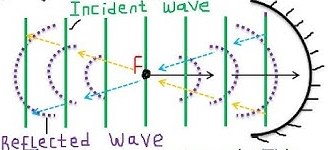
When plane waves falls onto a concave reflector, they converge to a point in front of the reflecting surface. This is the same way all rays of light parallel and close to the principal axis converge after reflection. The plane waves will be reflected as circular waves that seems to change direction after the converging point. see the figure below:
straight and circular waves: plane waves incident to convex(diverging) reflector
When plane waves meets a convex reflector. they are reflected such that they appear to diverge diverge. from a point behind the convex surface. The waves reflected from convex reflector has virtual principal focus.
circular waves against a straight reflector.
Circular waves incident to a straight reflector will be reflected as circular waves. These waves seem to have a converging point behind the plane reflector. see the figure below:
circular waves incident to the concave reflector straight up and moves as plane waves after reflection. See the figure below.
Electrostatics is a branch of physics that deals with behavior and properties of charges that are not flowing. When we subject materials to mechanical friction force against other materials, the electrons near the surface jump out from one material and become lodged to the other material. In other word, when materials rub each other, electrons are transferred. The transfer of electrons is what is referred as charging of the material.
Materials are made from matter and matter is made of atoms. Atoms are considered to be very tiny particles whose size is in the order of 0.1 nanometers and that cannot be divided further. Atom is considered as the blue print of every matter whether it is a gas, liquid or solid. They are the basic structures that are joined together to make molecules that composes matter.
Electrostatics: Structure of an atom
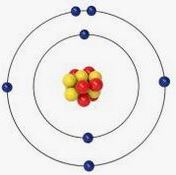
Atom is made up of two parts, a central core called nucleus and outer orbits where electrons goes around the nucleus. The nucleus contains particles called protons and neutrons closely and tightly packed inside.
Protons carries a positive charge whereas electrons carries negative charges. Neutrons carries no charge.
The number of protons and electrons in an atom are equal in number such that the resultant charge is zero. This is because there are equal number of positive charge as there are negative charge so that they cancel out each other making the overall charge in an atom to be zero.
Causes of electrostatics charging
In some materials , electrons are not tightly bund to the nucleus and so when given some little energy, they tend to jump out of the atom. When two materials are rubbed against each other, the heat energy developed due to friction may cause some loosely held electrons from one material to move and be transferred to the other material. Some materials easily losses elecrons whereas others readily accepts electrons during friction.
Materials that losses electrons are said to be positively charged because they have overall more positively charged protons compared to electrons.
Materials that gains electrons are said to be negatively charged because they have overall more negatively charged electrons as compared to the protons. As an example, when polythene is rubbed against flannel clothe, it gains electrons and becomes negatively charged . Consequently, flannel clothe becomes positively charged because it looses some of its negatively charged electrons to polythene.
Glass will loose electrons to silk when they are rubbed together making the glass to gain positive charge and silk to be negatively charged.
The following has been observed when materials have been charged by friction.
Excess negative charge on one body is equal to excess of positive charge on the other body and so no new charges is ever created. In electrostatics charges are never created, they are only transferred.
Some materials will always acquire they same type of charge during charging and so it may be possible to predict the charges on materials after you rub them together.
The quantity of charge in some cases maybe small and in some cases charges may escape before they are detected. When charging by friction, the idea environment is a dry atmosphere and clean charging bodies to avoid discharge.
Some Experiments to explain electrostatic charges
Take a polythene strip and rub it against silk and then take the strip near a thin stream of flowing tap water as shown:
When a charged strip is brought near a thin stream of water, the of water is strongly attracted to the polythene as shown.
when a plastic comb, pen or plastic ruler is rubbed against your clothe or hair, it is observed to attract small pieces of paper as shown.
A household mirrors and windows attract dust and other particles when wiped with a dry clothe because of electrostatic charges.
All the above observations are as a result of electrostatic charges.
There are two types of charges namely negative and positive charges. The SI unit of charge is the coulomb(c).
1 Coulomb = 1000 millicoulombs
millicoulomb = 1000 microcoulombs
1 coulomb = 1000 000 microcoulombs
The basic law of charges
The basic law of charges states that like charges repel, unlike charges attract. In this lesson, we will discuss physics experiments that can verify this basic law.
Experiments to verify the law of charges
To investigate what happens when two charges bodies are brought together, you may need the following apparatus:
glass rods
silk cloth
Silk Thread
Stand
Bunsen burner
polythene rod
duster
To investigate the law of charges in electrostatics, use the following procedure:
Dry glass rod by running it over a Bunsen flame a few times.
rub the dry rod with a silk and then suspend it by a thread on a stand
Dry a second glass rod over bunsen burner and rub it with silk cloth.
Hold the second glass rod close to the first suspended glass rod as shown.
With the glass rod still suspended, bring a polythene rod rubbed with fur close to it as shown.
Observations from experiments on law of charges
when a charged glass rod is moved close to a suspended charged glass rod, they were observed to repel each other.
When a charged polythene rod is moved close to a suspended charged glass rod, they were observed to repel each other.
Explanation
The glass rods were rubbed with the same material and so they acquired same positive charge . The repulsion between them implies that like charges repel each other.
When polythene rod was rubbed with fur, it acquired negative charge. When the charged polythene rod attracts the positively charged glass rod, it shows that opposite charges attracts each other. The above experiment and observations brings us to conclusions on charges with the basic law of charges that states that like charges repel while unlike charges attract.
The basic law of charges states that like charges repel, unlike charges attract. In this lesson, we will discuss physics experiments that can verify this basic law.
Experiments to verify the law of charges
To investigate what happens when two charges bodies are brought together, we need the following apparatus:
glass rods
silk cloth
Silk Thread
Stand
bunsen burner
polythene rod
duster
To investigate the law of charges, use the following procedure:
Dry glass rod by running it over a Bunsen flame a few times.
rub the dry rod with a silk and then suspend it by a thread on a stand
Dry a second glass rod over bunsen burner and rub it with silk cloth.
Hold the second glass rod close to the first suspended glass rod as shown.
With the glass rod still suspended, bring a polythene rod rubbed with fur close to it as shown.
Observations from experiments on law of charges
when we moved a charged glass rod close to a suspended charged glass rod, we observe them to be to repelling each other.
When a charged polythene rod is moved close to a suspended charged glass rod, they were observed to repel each other.
Explanation
The glass rods were rubbed with the same material and so they acquired same positive charge . The repulsion between them implies that like charges repel each other.
When polythene rod was rubbed with fur, it acquired negative charge. When the charged polythene rod attracts the positively charged glass rod, it shows that opposite charges attracts each other. The above experiment and observations brings us to conclusions on charges with the basic law of charges that states that like charges repel while unlike charges attract.
Atomic structure describes how an atom is built from protons, neutrons, and electrons. At the center of the atom is the nucleus, containing positively charged protons and neutral neutrons. Negatively charged electrons orbit the nucleus in shells, with their negative charge attracting the positive protons to hold the atom together. Atoms are electrically neutral because they have an equal number of protons and electrons.
The nucleus of an atom has a specific number of protons and neutrons. The number of protons in the nucleus is called the atomic or proton number. When the number of protons and the number of neutrons in the nucleus are summed up, the resultant number is known as the mass number. Mass number is also known as the nucleon number.
Different atoms has different mass number. For example, hydrogen atom has mass number of 2, meaning it has 1 neutron and 1 proton in it’s nucleus. A neon atom has mass number as 20 having 10 protons, 10 neutrons and 10 electrons. similarly, helium atom has mass number 4 with 2 protons, 2 neutrons and 2 electrons.
describing the mass number in atomic structure
If a certain atom X has atomic number Z with N neutrons and mass number A, then we can express it as:
$$^{A}_{Z}X \ \ \ where A = Z + N$$
Thus neon, helium and hydrogen atom will be represents as:
where Ne is neon atom, He is the helium atom and H the hydrogen atom.
There exists atoms that have the same atomic number but with different mass numbers. Such atoms are said to be isotopes. For example carbon-14 and carbon-12 has mass number 14 and 12 respectively but both has atomic mass 6.
The two will be represented as shown:
$$^{12}_{6}C \ \ and \ \ ^{12}_{6}C $$
Stability of the nuclear in atomic structure
A nuclear is said to be stable when a ratio of it’s proton to neutron number is 1 or close to 1. that is
$$\frac{\text{mass of proton}}{\text{mass of neutron}}=1$$
As atoms gets heavier, there is a marked deviation from this ratio, with the neutron number exceeding that of protons. This causes the nucleus to be unstable and hence increases chances of the nuclear disintegrating to gain stability. A graph of number neutrons N against number of protons Z for different nucleus is illustrated below.
From the graph, it is observed that the stable nuclides are outside the stability line.
Nuclides above the stability lines have too many neutrons. Such nuclides decays in such a way that the number protons increases.
Nuclides below the stability line have too many protons . Therefore, they decay to decrease the number of protons.
Contains information related to marketing campaigns of the user. These are shared with Google AdWords / Google Ads when the Google Ads and Google Analytics accounts are linked together.
90 days
__utma
ID used to identify users and sessions
2 years after last activity
__utmt
Used to monitor number of Google Analytics server requests
10 minutes
__utmb
Used to distinguish new sessions and visits. This cookie is set when the GA.js javascript library is loaded and there is no existing __utmb cookie. The cookie is updated every time data is sent to the Google Analytics server.
30 minutes after last activity
__utmc
Used only with old Urchin versions of Google Analytics and not with GA.js. Was used to distinguish between new sessions and visits at the end of a session.
End of session (browser)
__utmz
Contains information about the traffic source or campaign that directed user to the website. The cookie is set when the GA.js javascript is loaded and updated when data is sent to the Google Anaytics server
6 months after last activity
__utmv
Contains custom information set by the web developer via the _setCustomVar method in Google Analytics. This cookie is updated every time new data is sent to the Google Analytics server.
2 years after last activity
__utmx
Used to determine whether a user is included in an A / B or Multivariate test.
18 months
_ga
ID used to identify users
2 years
_gali
Used by Google Analytics to determine which links on a page are being clicked
30 seconds
_ga_
ID used to identify users
2 years
_gid
ID used to identify users for 24 hours after last activity
24 hours
_gat
Used to monitor number of Google Analytics server requests when using Google Tag Manager